
Last updated November 18, 2026
Choosing the Right Insulation Brand: A Buyer’s Guide for Enterprise
Here’s a number worth sitting with: several of the top-selling blown-in insulation products installed across Nevada are rated by their manufacturers at test conditions of 75°F. Enterprise attics regularly hit 155 to 165°F in July and August. The published R-value on those bags assumes a temperature your attic never sees, and the drop-off at 160°F is real, documented in the manufacturers’ own technical data, and almost never mentioned at the point of sale. This guide is for homeowners in Enterprise who want to ask better questions than “which brand is best” – the questions that actually determine whether your insulation performs. We’ll cover how to read a spec sheet, how fiberglass, cellulose, and mineral wool behave under sustained heat, and how to verify the exact product a contractor plans to install.
Quick Answer
There is no single “best” insulation brand for Enterprise – the right choice depends on whether the specific product holds its rated R-value at the 155 to 165°F temperatures your attic reaches in summer. The key is to find the manufacturer’s high-temperature performance data, not just the standard 75°F rating, and confirm the exact SKU before signing. Fiberglass, cellulose, and mineral wool each behave differently under sustained heat, and a contractor who can talk through those differences with real numbers is more valuable than a familiar logo on the bag.
Table of Contents
- Why R-Value Isn’t the Whole Story in Enterprise Heat
- How to Read a Manufacturer’s Thermal Performance Data Sheet
- Fiberglass vs. Cellulose vs. Mineral Wool Under Extreme Heat
- What GreenGuard Gold and Similar Certifications Actually Verify
- How to Verify the Exact Product SKU Before You Sign
- Warranty Terms Vary by 20+ Years – What a Contractor Should Add
- Common Mistakes to Avoid
- When to Call a Professional
Why R-Value Isn’t the Whole Story in Enterprise Heat
R-value measures a material’s resistance to heat flow, but it’s not a constant – it changes with temperature. The number printed on every bag of insulation is calibrated at a standard test condition of 75°F, roughly the temperature of a mild indoor room. That’s fine as a baseline for comparing products on paper. It tells you almost nothing about how the product behaves in an Enterprise attic in August, where the air temperature near the roof deck routinely sits between 155 and 165°F during the afternoon peak.
At those temperatures, different materials lose thermal resistance at different rates. Dense fiberglass products tend to hold up better than many homeowners assume, while some loose-fill products and certain foam formulations see more significant reduction. The precise numbers depend on the product, not the brand umbrella – two fiberglass batts from the same manufacturer can perform very differently in the heat.
What this means for you:
- A nominal R-38 that holds its value at 160°F is worth more than a nominal R-49 that collapses under heat.
- The brand name on the bag tells you who made it, not which formulation that specific product uses.
- Enterprise’s climate makes the high-temperature performance data more important than in most of the country.
- Any contractor who quotes R-value alone, without acknowledging the temperature effect, is either simplifying or hasn’t looked at the data.
This is why we treat the material spec sheet as the starting point for every conversation in Enterprise, not the finish line. The question shifts from “which brand” to “which product, and does it hold up under our conditions.” That change in framing is where real value gets delivered.
How to Read a Manufacturer’s Thermal Performance Data Sheet
Every insulation manufacturer publishes a technical data sheet for each product – not the marketing brochure, the actual spec sheet. It’s usually a two- to four-page PDF you can find by searching the manufacturer’s name plus the product name plus “technical data sheet.” Here’s what to look for, in order.
- Locate the “k-value” or “thermal conductivity” table. This is where the product’s performance at various mean temperatures is listed. The standard condition is 75°F, but many data sheets include columns at 40°F, 75°F, and sometimes 100°F or higher.
- Look for an elevated temperature column. If the sheet only lists 75°F, that’s a red flag. Either the manufacturer hasn’t published higher-temperature data, or they haven’t included it because it doesn’t favor the product. Ask.
- Check the stated R-value at the thickness you’re installing. R-value is a function of both the material’s conductivity and how thick the layer is. A product’s rated R-value only applies at the specified thickness and density; if the installer underfills the cavity, you don’t get the rated number.
- Look for density and settled thickness. Loose-fill products settle over time. The data sheet specifies the “settled” R-value, not the “installed” value – the difference can be 10 to 15%. The installer should account for this by overblowing.
- Note the “aged R-value” if it’s spray foam. Foam products often have an initial and an aged R-value, and the aged figure is the honest one for comparison. Check both.
Once you’ve done this for two or three products, you’ll have a real basis for comparison. The data sheets don’t always agree with the marketing language, and the gap between them is where homeowners get sold the wrong product for the wrong reason. In Enterprise, we ask for the spec sheet on every job before we quote a material – it’s how we confirm the product actually fits the attic we’re working in.
Fiberglass vs. Cellulose vs. Mineral Wool Under Extreme Heat
The three main families of blown-in insulation – fiberglass, cellulose, and mineral wool – behave differently under sustained high temperatures. The differences are measurable and matter in Enterprise’s climate.
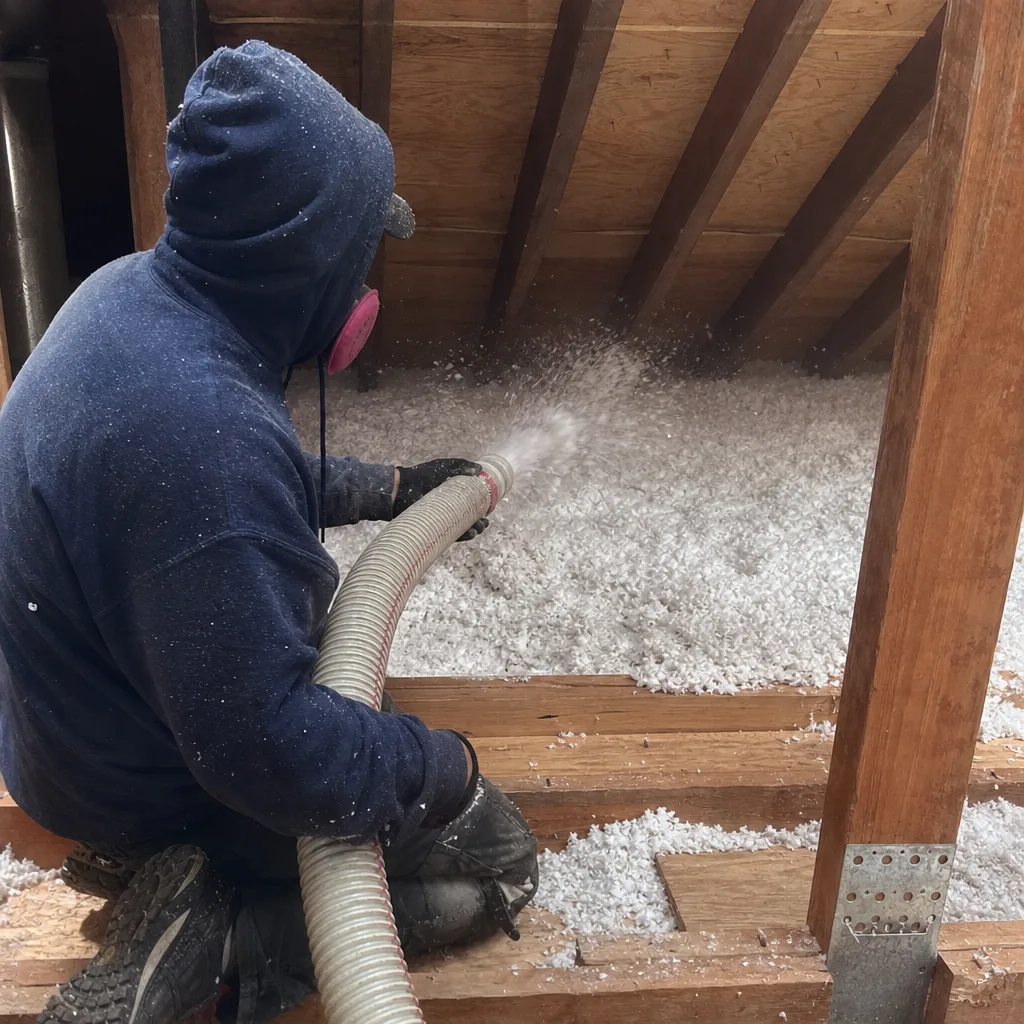
Fiberglass (Owens Corning, Johns Manville, Knauf) is a glass-fiber product with excellent fire resistance and, in dense-pack and loose-fill forms, relatively stable thermal performance across a range of temperatures. The better fiberglass products are tested at both standard and elevated conditions and hold their R-value reasonably well. The catch is that performance varies by density – loose-fill fiberglass at low density loses more R-value than dense-pack fiberglass at higher density. Ask for the density, not just the brand.
Cellulose (GreenFiber) is recycled paper fiber treated with fire retardants. It has excellent sound-dampening qualities and solid thermal performance, but its fire retardants (typically boric acid or ammonium sulfate) can degrade under sustained heat over long periods. Cellulose also settles more than fiberglass, and its R-value per inch at high temperatures is typically lower than dense fiberglass. That doesn’t make it a bad choice – it makes it the wrong choice for an attic that regularly hits 160°F without careful installation.
Mineral wool (Rockwool) is made from rock and slag, and it’s the most heat-stable of the three families. Mineral wool is non-combustible and holds its thermal performance better at sustained high temperatures than either fiberglass or cellulose. It also doesn’t settle the way cellulose does. The trade-off is cost and density – mineral wool is heavier and typically more expensive per square foot than fiberglass or cellulose. Whether that premium is worth it depends on the attic and the budget.
Spray foam (Icynene, Demilec) is a separate category with its own set of trade-offs. Closed-cell spray foam has a very high R-value per inch and acts as an air barrier, but its thermal performance also drops at high temperatures. Open-cell foam is cheaper and still a strong air-sealer. If you’re considering spray foam insulation in Enterprise, the temperature discussion applies here too – just in a different form.
What GreenGuard Gold and Similar Certifications Actually Verify
GreenGuard Gold is an indoor air quality certification. It verifies that a product has been tested for low chemical emissions – specifically, volatile organic compounds (VOCs) – under a third-party testing protocol. For spray foam and any product that off-gasses during installation, this is meaningful. It tells you the product has been checked by an independent lab against a defined emissions threshold.
Here’s what it does not verify: thermal performance at any temperature, R-value retention, fire resistance, structural integrity, or durability. A product can carry GreenGuard Gold and still lose half its R-value at 160°F. A product can carry GreenGuard Gold and still be installed incorrectly.
Other certifications work the same way. Look for:
- ASTM E84: This tests surface burning characteristics. It’s about fire safety, not thermal performance.
- ASTM C518: This tests thermal conductivity. The data sheet from this test is where you find the actual R-value numbers, including at elevated temperatures.
- ASTM C739 or C764: These are loose-fill density and thickness standards. They ensure consistency between manufacturers.
- GreenGuard or GreenGuard Gold: Air quality only.
A certification is a starting point, not an answer. The certification that matters most for Enterprise homeowners is the high-temperature R-value column on the ASTM C518 test data – not the emissions certificate. Ask for both, and know which one you’re looking at.
How to Verify the Exact Product SKU Before You Sign
The most common insulation failure we see isn’t a bad product – it’s a good product installed in the wrong application, or a different product substituted without the homeowner’s knowledge. The fix is simple: ask for the SKU.
Every insulation product has a manufacturer’s item number – a SKU or product code that identifies the specific formulation, density, and packaging. If you sign a quote that says “fiberglass blown-in insulation, R-49,” you’ve agreed to a category, not a product. The contractor can install anything in that category and still be “in compliance” with the quote. That’s not how you want this to work.
A quote that names the SKU – for example, a specific Owens Corning, Knauf, or CertainTeed product code – gives you something you can verify. Follow this process:
- Ask for the product name, SKU, and manufacturer’s spec sheet before signing anything. A contractor who’s confident in the product will provide this without hesitation.
- Search the manufacturer’s website for the SKU and download the technical data sheet. The data sheet should have the R-value at your target thickness and, ideally, at elevated temperature.
- Confirm the product’s intended application. Most insulation products have a stated use – attic, wall, ceiling, crawl space. If the product you’re being quoted is designed for walls and you’re having the attic insulated, ask why.
- Check the quote against the spec sheet. The installed thickness (measured in inches, not just R-value) should match the manufacturer’s recommendation for the target R-value at your attic’s conditions.
- Confirm the installer is using the product correctly. Blown-in fiberglass at low density, or under-filled cavities, won’t deliver the rated R-value. The spec sheet tells you what density you’re paying for.
This process takes about 15 minutes and prevents the most expensive insulation mistakes. When a contractor can’t produce a SKU, that’s information too. For homeowners considering attic insulation upgrades, our team at attic insulation in Enterprise walks through the SKU and spec sheet on every quote, so there’s no ambiguity about what’s going into the attic.
Warranty Terms Vary by 20+ Years – What a Contractor Should Add
Insulation product warranties vary widely in length and terms. Some manufacturers offer limited warranties of 20 to 30 years; others offer 5, 10, or 25 years. The terms matter as much as the length – what’s covered, what’s excluded, and who’s responsible for labor if the product fails.
Here’s the practical issue: most manufacturer warranties cover the product itself (replacement material), not the labor to remove and reinstall. If a spray foam product fails at year seven because of a manufacturing defect, you may get new foam delivered to your driveway and a labor bill for the tear-out and reinstallation. The warranty math matters.
That’s why the contractor’s own guarantee is as important as the product warranty. A good insulation contractor stands behind the installation – meaning the labor, the removal, and the reinstallation – for a defined period. At Aspen Attic Insulation Enterprise, we back every job with our 365-Day Done Right Promise, which is in writing on every quote and covers labor and materials for a full year. If the job needs a second visit within that year to make it right, that visit is free.
The product warranty and the contractor guarantee work together, not instead of each other. Ask any contractor:
- What’s the product warranty, in years, and does it cover labor?
- What’s your own written guarantee, and what does it cover specifically?
- If the product fails within the guarantee period, who schedules the replacement – the manufacturer or you?
- Is the guarantee transferable if I sell the home?
A contractor who can’t answer these questions clearly is a risk. A contractor who puts the answers in writing before any work starts is what you’re paying for.
Common Mistakes to Avoid
- Quoting by R-value alone. A high nominal R-value that collapses at 160°F is worth less than a lower nominal R-value that holds. Ask for the elevated-temperature performance every time.
- Trusting the logo on the bag. Two products from the same manufacturer can perform very differently. The brand is the manufacturer; the SKU is the product. Verify the SKU.
- Skipping the spec sheet. The technical data sheet tells you what the marketing brochure doesn’t. If you don’t see an elevated-temperature column, ask why.
- Accepting a verbal quote. A written price before work starts is standard at every reputable insulation shop. If you’re getting a “we’ll figure it out after,” walk away.
- Ignoring the installation effort. Blown-in fiberglass at low density, or spray foam applied too thin, won’t deliver the rated R-value no matter how good the product is. Ask about the density and thickness the installer will use.
- Assuming builder-grade insulation is adequate. In Enterprise attics that regularly exceed 150°F, builder-grade materials often need to be evaluated against high-temperature performance before they’re trusted for the life of the home.
When to Call a Professional
Insulation work involves the attic – a space with limited access, high temperatures, and, in some homes, existing electrical work and gas appliances. That combination makes it a job for a trained professional, not a weekend project. Call a professional if:
- Your attic has no insulation, or the existing insulation is visibly compacted, damaged, or wet.
- You notice hot rooms in summer, cold rooms in winter, or uneven temperatures across floors.
- Your energy bills have climbed without a corresponding change in use.
- You’re considering spray foam, which requires careful application and curing conditions.
- You’re planning a remodel that opens the attic – insulation upgrades are much cheaper as part of one.
- You want to verify the exact product and R-value your attic needs. This is where a spec sheet and a knowledgeable contractor earn their fee.
If you’re in Enterprise and want to know which product and R-value make sense for your attic, Aspen Attic Insulation Enterprise offers free estimates in Enterprise – call (844) 761-9996 for a free estimate and a written price before any work starts.
Frequently Asked Questions
There’s no single best brand – the right choice depends on the specific product’s high-temperature performance. Mineral wool products generally hold their R-value better than cellulose or fiberglass at sustained 155 to 165°F attic temperatures, but the better fiberglass products perform well too at appropriate density. Ask for the SKU and the elevated-temperature data sheet, not just a brand name.
Download the manufacturer’s technical data sheet for the specific product SKU and look for the “k-value” or “thermal conductivity” table. If the sheet includes columns for temperatures above 75°F – typically 100°F or 110°F – read the R-value at the highest temperature listed. If no elevated column exists, ask the manufacturer directly whether higher-temperature data is available.
No. GreenGuard Gold verifies low chemical emissions for indoor air quality – it says nothing about thermal performance, R-value retention at high temperatures, or fire resistance. It’s a useful certification for spray foam products that off-gas during installation, but it’s not a substitute for the thermal performance data sheet. Ask for both.
Yes, and you should. Ask for the product name and SKU on the written quote, then look up the manufacturer’s spec sheet for that SKU. A reputable contractor will provide the SKU, the spec sheet, and the installed thickness. At Aspen Attic Insulation Enterprise, we include the product SKU and spec sheet on every quote, and we put the written price in front of you before any work starts.
Manufacturers offer different warranty terms based on the product’s warranty philosophy, the material’s expected service life, and the manufacturer’s willingness to cover labor versus material only. Some warranties are 20 to 30 years; others are shorter. The key question isn’t just the length – it’s whether labor is covered and whether the contractor’s own guarantee fills that gap. Our 365-Day Done Right Promise is in writing on every job, with a free second visit if the work needs to be corrected.
That depends on the attic and what’s already there. Spray foam seals air leaks and offers high R-value per inch, which suits certain attic configurations. Blown-in insulation is often the more cost-effective option for open attics that already have some insulation. Both are covered under our spray foam insulation in Enterprise and blown-in insulation in Enterprise pages – and both should be evaluated on high-temperature performance, not just headline R-value. If you’re not sure which fits, call (844) 761-9996.
The Bottom Line
The best insulation brand for an Enterprise attic isn’t the one with the most familiar name – it’s the one whose specific product holds its rated R-value at 155 to 165°F. Ask for the manufacturer’s high-temperature performance data, not just the standard rating. Compare fiberglass, cellulose, and mineral wool on their actual thermal behavior under sustained heat. Look at what certifications verify – GreenGuard Gold is about air quality, not performance. Verify the exact SKU before signing, and make sure the contractor’s own guarantee covers the installation, not just the product. The homeowner who asks these questions gets insulation that works; the one who doesn’t gets a bag with a logo on it.
Written by the team at Aspen Attic Insulation Enterprise.