
Last updated November 18, 2026
The Complete Guide to Insulation in Enterprise
Most insulation guides are written for a hypothetical American home. Enterprise homes don’t live in that house. Here, attic temperatures climb past 160°F in July, the desert drops 40 degrees after sundown, and insulation installed to Clark County’s code minimum often loses ground within a few summers. We’ve walked enough attics in Enterprise to see the pattern: homeowners paying $400 – $600 a year too much to cool a space that was insulated for a milder climate. This guide covers what actually works here, from R-values to radiant barriers to reading your own energy audit.
Quick Answer
In Enterprise, Nevada, the right attic insulation should target R-49 to R-60, pair blown-in fiberglass or cellulose with a radiant barrier, and be installed to a standard well above Clark County’s Title 24 code minimum. Code minimum is a floor, not a target, because Enterprise’s summer heat load runs higher than the climate zone assumes.
Table of Contents
- Why Enterprise’s Microclimate Changes the Insulation Math
- Clark County Title 24: Why Code Minimum Is Not Enough
- How 160°F Attic Heat Degrades Standard Batt Insulation
- The Radiant Barrier + Blown-In Combination
- What R-Value You Actually Need in Enterprise
- How to Read an Energy Audit Report
- Matching Materials to Enterprise Conditions
- When to Insulate in Enterprise (Season and Timing)
Why Enterprise’s Microclimate Changes the Insulation Math
Enterprise sits in the southern Las Vegas Valley, south of the 215 Beltway and close to the Sloan Canyon foothills. That geography produces a specific thermal profile: intense direct sun on south- and west-facing roof planes, very low humidity, and a strong overnight cooldown that shocks materials between day and night. The result is an attic that can hit 160°F or more on an August afternoon and fall toward 90°F by 2 a.m.
That swing matters. Insulation isn’t just a resistance number on a spec sheet. It’s a material that expands and contracts, and in Enterprise it does that about 300 days a year. Fiberglass batts that look fine in a lab-rated 100°F environment can settle, compress, and lose R-value faster here than their manufacturer ratings suggest, because the ratings are calculated at a steady 75°F mean temperature.
We’ve opened attics in the Enterprise neighborhoods around Coronado High School and along Horizon Ridge where 12-year-old R-30 batts measured closer to R-22 once settled and heat-cycled. The homeowner wasn’t doing anything wrong. The material was simply installed to a milder-climate assumption.
Three microclimate factors drive every recommendation we make in Enterprise:
- Peak attic heat. 160°F+ in summer, higher under unshaded west-facing roof planes.
- Diurnal swing. A 40°F drop from afternoon to night accelerates material fatigue.
- Zero humidity buffer. Dry air means no moisture to help regulate thermal mass, so heat gain through the ceiling assembly is more direct.
None of this shows up in a generic insulation calculator. It shows up on your July bill.
Clark County Title 24: Why Code Minimum Is Not Enough
Clark County enforces Title 24 of the California Energy Code as adopted for Nevada, and the minimum attic R-value for new construction in Enterprise typically lands in the R-38 to R-49 range depending on the assembly and HVAC system. That number is a legal floor, not an optimized target for this climate.
Code minimums are calculated against a climate zone average. Enterprise’s summer load – the number of hours per year your HVAC runs against that attic heat – pushes past what the zone model assumes. A house insulated to code minimum in Enterprise will technically pass inspection and still underperform on the utility bill.
We tell homeowners in Enterprise to think of Title 24 the same way you think of a car’s minimum safety rating. It’s not what you aim for. It’s what you must not fall below. Building to code plus 25% in an Enterprise attic is closer to right, and often that means pushing to R-49 or R-60 even when the permit only asks for R-38.
The tougher problem is existing homes. Thousands of Enterprise homes built between 1995 and 2010 were insulated to the code in force at the time, which for some years meant R-19 or R-30 in the attic. Those homes are functional and legal and losing money every July. If you’ve never looked at your attic insulation depth, that’s the first number to check.
How 160°F Attic Heat Degrades Standard Batt Insulation
Batt insulation is tested at a standardized mean temperature, usually 75°F. At that temperature, R-13 batt performs at R-13. At 160°F in an Enterprise attic, the effective R-value of the same batt is measurably lower – not because the product is bad, but because thermal conductivity rises with temperature.
The compounding problem is physical degradation. Repeated cycling between 160°F and 90°F causes fiberglass batts to compress at the edges, pull away from rafters, and develop gaps that thermal bridging then exploits. Once a batt slips or compresses, the R-value printed on the bag no longer describes the R-value in your attic.
What we see in Enterprise attics after 8 – 12 years:
- Edge gaps where batts have pulled away from the top plate, creating airflow channels.
- Compressed batts under HVAC platforms and walkways, losing 30 – 50% of rated R-value.
- Displaced batts from past trades (cable, plumbing) that were never re-laid correctly.
- Heat-stained-facing on older batts where the kraft paper has baked and curled.
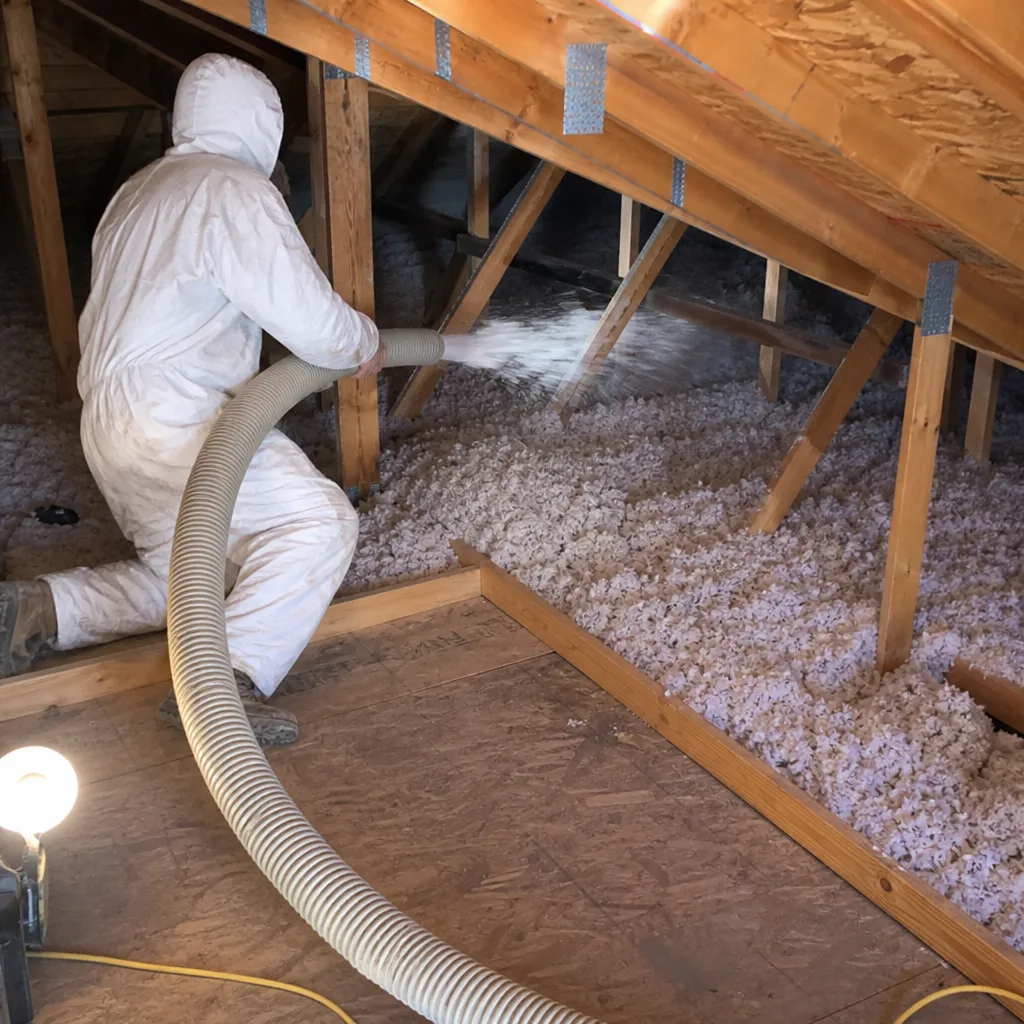
Blown-in fiberglass and cellulose hold up better in this climate because they fill gaps and don’t rely on a rigid structure. That’s a big part of why our Blown In Insulation in Enterprise work is the default recommendation for existing Enterprise attics.
The Radiant Barrier + Blown-In Combination
Radiant barriers and blown-in insulation are usually sold as separate upgrades. In Enterprise, they work best as a pair, and the combination outperforms either one alone by a meaningful margin.
Here’s the logic. A radiant barrier (typically a foil-faced product stapled to the underside of the roof deck) blocks 90%+ of the radiant heat the sun drives into the attic. Blown-in insulation on the attic floor slows conductive and convective heat transfer from the attic through your ceiling. Alone, either one leaves a pathway open. A radiant barrier without floor insulation still lets that hot attic air conduct through drywall. Floor insulation without a radiant barrier fights the full radiant load the roof is dumping into the attic.
In Enterprise, where the roof deck itself can hit 170°F on a west-facing plane, the radiant barrier is doing serious work. Our experience across Las Vegas Valley attics is that the pair together typically cuts cooling load more than the sum of each upgrade done separately over an 8 – 10 year window.
Two things to know:
- Radiant barriers must face an air gap to work. Foil stapled tight to the deck is fine; foil glued flush against a surface does very little.
- They don’t replace R-value. A radiant barrier is rated in emissivity, not R-value. You still need adequate floor insulation underneath it.
For homes with accessible roof decks and existing low-R attics, this pairing is our most common full-attic recommendation in Enterprise. For homes with complicated roof geometry or finished attic spaces, spray foam often becomes the better answer – more on that below.
What R-Value You Actually Need in Enterprise
The R-value you need depends on three things: how much of your attic is conditioned space, how the HVAC ducts are routed, and how much of your summer cooling load you’re willing to keep paying for.
For a typical Enterprise single-story home with ducts in the attic, here’s the range we recommend:
- Bare minimum (new construction passing Title 24): R-38 – legal, but undersized for the climate.
- Recommended for existing occupied attics: R-49 to R-60.
- High-performance band (with radiant barrier, sealed ducts, and air sealing): R-60 to R-70 in the attic floor, which is typically 16 – 20 inches of blown-in fiberglass or cellulose.
Most contractors in Enterprise quote R-38 by default because it’s what the permit asks and it’s what fits on a single estimate line. We don’t. If your house was built before 2015 and has never been re-insulated, you’re probably sitting at R-19 to R-30 right now, and jumping to R-49 will be the single biggest efficiency move available.
If you’re lucky enough to have a spray foam attic where the roof deck is insulated and the attic is semiconned, the R-value target shifts. Roof-deck spray foam in Enterprise should land at R-20 to R-30 for open-cell and R-6 to R-10 per inch for closed-cell, which is a different conversation covered on our Spray Foam Insulation in Enterprise page.
How to Read an Energy Audit Report
An energy audit report tells you where the heat is actually going. It should never be treated as a sales pitch, and you shouldn’t accept an insulation recommendation until you can trace it back to a specific line in that report.
Here’s the sequence we recommend to Enterprise homeowners reading their own audit:
- Find the blower door number. It’s listed in CFM50 and tells you how leaky the house is. A tight house leaks less than 3.0 ACH50; anything above 5.0 is notable air leakage that insulation alone won’t fix.
- Look at the pre-upgrade R-value row. The auditor should have measured existing insulation depth and product. If they didn’t open the attic access, question the report.
- Check the duct leakage percentage. In Enterprise attics, duct leakage over 10% is common. If ducts are leaking, adding attic insulation helps less than sealing the ducts first.
- Read the ceiling heat flux estimate. This is the number most homeowners skim past. It tells you how many BTUs per hour are conducting through the ceiling – the load your insulation upgrade is sized to fix.
- Compare recommended R-value to the heat flux. An honest recommendation will show you the model output, not just a suggested R-value in the summary.
If your insulation salesperson can’t walk through these numbers with you, that’s a signal. Our team walks Enterprise homeowners through the full report before any work scope is written. If a recommendation doesn’t have a number behind it, ask why.
Matching Materials to Enterprise Conditions
There is no single best insulation material. There’s the right material for the assembly and the climate, and in Enterprise the climate amplifies the consequences of picking wrong.
Blown-in fiberglass (Owens Corning, Johns Manville) is our general recommendation for existing attic floors. It fills gaps around trusses and ductwork, resists settling better than batts, and doesn’t support mold growth – important given Enterprise’s dry but occasionally monsoon-humid late summer.
Blown-in cellulose is denser than fiberglass, which helps in attics with steep roof pitches or complex framing where airflow could otherwise channel through. It’s also a good choice when you want slightly better air-sealing performance from the material itself.
Rockwool is fire-resistant and sound-dampening, which makes it a strong choice for homes along busy corridors like St. Rose Parkway or near the 215.
Spray foam (Icynene, Demilec) is the right answer when the attic is conditioned, when ducts are in a semi-conditioned space, or when roof geometry makes floor insulation impractical. It’s also the superior air sealer. Use it where its properties solve a specific problem; don’t use it as a default.
We keep eight material lines on hand (Owens Corning, Johns Manville, Knauf, Rockwool, CertainTeed, Icynene, Demilec, GreenFiber) because matching the material to the actual assembly always outperforms the “one product for everything” approach.
When to Insulate in Enterprise (Season and Timing)
Insulation can be installed year-round, but the practical sequencing matters in Enterprise. The best window is late October through March, when attic temperatures stay under 100°F and technicians can work safely for longer stretches without heat exhaustion risk.
If you’re replacing HVAC equipment, insulate before the new system is installed and before ducts are re-run. You want the insulation down first, then the ducts run over it – so you don’t compress the insulation by laying ductwork across new material.
If you’re doing a roof replacement, that’s the ideal moment to add a radiant barrier. Once the shingles are off, the deck is exposed and the barrier can be stapled clean against it without fighting awkward access.
And if you’re doing nothing else – if your attic is at R-19 and your July bill has been trending up for three summers – don’t wait for a project to happen first. Air sealing and blown-in are the lowest-cost, highest-return first move for most Enterprise homes. You can read more about how that service compares on our Attic Insulation in Enterprise page.
Common Mistakes to Avoid
- Insulating to code minimum and calling it done. Title 24 is a floor. Enterprise’s summer load runs hotter than the model, so a code-pass attic still loses money every July.
- Ignoring duct leakage before adding insulation. If your ducts are leaking 15% into the attic, you’re paying to condition air that never reaches a room. Seal the ducts first, insulate second.
- Stacking new batts over old ones without checking. We’ve seen attics around the Equestrian Park area with three layers of mixed R-value batts compressing the bottom layer and lowering total performance.
- Installing a radiant barrier without an air gap. A barrier pressed flat against the roof deck does almost nothing. The gap is what makes the foil work.
- Letting a contractor compress insulation under HVAC platforms or walkway boards. Compression kills R-value instantly. Platform and walkway areas should be insulated after the platform is built, not before.
- Trusting a recommendation that doesn’t cite your blower door and heat flux numbers. If the salesperson can’t show you where the number came from, the number is a guess.
- Skipping the attic access panel. A poorly sealed attic hatch is a heat leak that eats 5 – 10% of your upgrade’s value. It’s a $40 fix; don’t leave it out of scope.
When to Call a Professional
Call a professional when the attic access is difficult or unsafe, when you’re dealing with existing spray foam you need to remove (this requires specialized equipment), when ductwork is present in the attic and needs sealing before insulation, or when you simply want a verified audit number before writing a check. Don’t DIY spray foam in a closed space without respiratory protection and rated equipment – that’s a real safety issue, not a formality. Likewise, older Enterprise homes may have vermiculite or other legacy materials that require testing before anyone disturbs the attic floor. If you’re not sure what you’re looking at, don’t move it.
Aspen Attic Insulation Enterprise offers free estimates in Enterprise – call (844) 761-9996 and we’ll walk your attic, take the measurements, and put a written price in your hands before any work is scheduled. Every technician is background-checked, identity-verified, arrives in a marked uniform, and shows a photo ID badge – and you receive their name and photo before the visit. If anyone else arrives, the visit is free.
Frequently Asked Questions
Most Enterprise attic insulation projects land between $1,800 and $4,200 for blown-in upgrades, depending on attic square footage, existing R-value, and whether air sealing or a radiant barrier is included. Spray foam attic projects typically run $4,500 to $9,500. Call (844) 761-9996 for an exact quote – estimates are free.
Repair (adding R-value, re-laying displaced batts, air sealing) is cheaper than a full replacement in most Enterprise homes and gets you most of the efficiency benefit. Full replacement makes sense only when existing materials are damaged, contaminated, or fiberglass batts have comprehensively compressed under HVAC platforms. The written estimate should show line items for both, so you can compare directly.
We recommend R-49 to R-60 in the attic floor for a typical Enterprise single-story home, even though Clark County’s Title 24 minimum may only require R-38 for new construction. The higher target accounts for the 160°F peak attic temperatures in summer.
Blown-in fiberglass and cellulose hold their R-value well for 20+ years when installed at proper depth. Fiberglass batts degrade faster in Enterprise’s heat cycling – expect meaningful performance loss after 10 – 12 years, especially at the edges and under platforms. If your batts were installed when the home was built more than a decade ago, they’re probably due for an inspection.
Yes – they solve different parts of the same problem. The radiant barrier blocks radiant heat from the roof deck; the insulation slows conduction through the ceiling. In Enterprise, where roof decks hit 170°F, the combination outperforms either alone.
Yes, we do – we just schedule early mornings and take heat-safety breaks. But the ideal window is October through March, when attic temps are safer for longer work. Call (844) 761-9996 to schedule a free estimate and we’ll recommend the best timing for your specific attic.
Every insulation job we perform in Enterprise is backed in writing for 365 days, covering labor and materials. If the work fails within that year, we come back and make it right at no cost – that’s the free second visit, written into the guarantee. You get the guarantee in writing before any work begins, alongside the written price.
The Bottom Line
Enterprise isn’t a generic desert climate, and insulation installed to a milder-climate assumption costs homeowners real money here. The right approach is straightforward: target R-49 to R-60 instead of code minimum, pair blown-in insulation with a radiant barrier, seal ducts before insulating, and demand a written recommendation you can trace back to your own energy audit. Match the material to the assembly rather than defaulting to batts. When you’re ready to see what your specific attic actually needs, our Aspen Attic Insulation Enterprise home page covers how we work, and a live person answers the phone at (844) 761-9996 any hour. Free estimates, written prices, and the 365-Day Done Right Promise – before anyone shows up at your door.
Written by the team at Aspen Attic Insulation Enterprise.