
Last updated November 18, 2026
Insulation Warning Signs: An Enterprise Homeowner’s Reference Guide
The most common insulation failure sign in Enterprise is also the most ignored: an air conditioning system that runs more than 16 hours a day in July. That runtime pattern, in our experience, points to attic heat load about 70% of the time. But most homeowners assume the HVAC unit itself is failing and spend $3,000 or more on a repair that doesn’t fix the problem. Failing insulation in Enterprise rarely announces itself with a dramatic draft or a puddle on the floor. It whispers through your utility bills, your bedroom temperatures, and your HVAC’s runtime. This guide decodes those signals so you can diagnose the problem before it compounds.
Quick Answer
The most reliable signs of bad attic insulation in Enterprise are a cooling bill that climbs 15% or more year over year without a rate hike, rooms that run five degrees hotter than the thermostat setting, and an AC system that runs more than 16 hours a day in peak summer. If two of those three are true, the insulation is the first place to look, not the HVAC unit. An infrared thermometer scan and two months of utility bills can confirm the suspicion before you call anyone.
Table of Contents
- Reading Your Utility Bills for Insulation Failure
- The Room-by-Room Temperature Test
- Is It Insulation, HVAC, or Duct Leakage?
- Exterior Warning Signs on Stucco and Tile-Roof Homes
- Spotting Pest Damage From the Attic Hatch
- When Insulation Degrades Below Its Rated R-Value
- Why Enterprise’s Climate Accelerates Insulation Wear
Reading Your Utility Bills for Insulation Failure in Enterprise
Your utility bills are the cheapest diagnostic tool you own. Two consecutive summers of bills tell a story about whether your attic is holding its R-value or has quietly given it up. Here’s how to run the test:
- Pull the same month from two years running. Compare, say, July 2024 to July 2025. Same house, same habits, same rate plan.
- Strip out rate changes. Divide total dollars by total kilowatt-hours to get your effective rate. If the rate rose 4% and the bill rose 19%, the extra 15% is your usage climbing.
- Compare against the neighborhood average. NV Energy bills in Enterprise often run $210 to $340 in July for a 1,800-square-foot home with a functioning attic. If yours is pushing $400, that gap is likely insulation, not bad luck.
A 15% year-over-year climb in cooling cost, with no rate hike and no new appliances, is the clearest bill-based signal we see in Enterprise. Attic insulation that has settled, compressed, or taken on moisture loses R-value gradually, so the bill drift is slow enough that most homeowners don’t notice until they’ve paid an extra $600 to $1,200 over two summers. That’s often more than the cost of topping the attic back up.
The Room-by-Room Temperature Test Any Homeowner Can Run
You don’t need a $300 thermal camera. A basic infrared thermometer, $12 at any hardware store, will tell you whether your attic insulation is doing its job. The test takes about 20 minutes on a hot afternoon:
- Pick a day over 100°F. That’s most July and August afternoons in Enterprise.
- Set the thermostat to 78°F and let it stabilize for two hours.
- Measure the ceiling temperature in every room, holding the thermometer about six inches below the ceiling and away from vents.
- Write it down. A well-insulated attic ceiling in Enterprise should read within 3 to 5 degrees of the thermostat setting. A ceiling reading 8 degrees or more above the setpoint is a red flag.
If the master bedroom ceiling reads 86°F while the hallway reads 81°F, the attic over the bedroom either has thinner coverage, displaced insulation, or a duct running through an uninsulated chase. In Enterprise’s stucco homes, the west-facing rooms are usually the worst offenders. That uneven reading pattern, more than any single number, is what tells us where to look first.
Is It Insulation, HVAC, or Duct Leakage? Sorting the Three Suspects
A sudden spike in cooling cost has three common culprits, and they don’t cost the same to fix. Before you sign a $3,000 HVAC replacement, work through this decision path:
- HVAC failure usually shows up as a system that won’t hold temperature at all, icing on the refrigerant lines, or a compressor that short-cycles. A tech can diagnose this in an hour.
- Duct leakage typically means one or two rooms are dramatically worse while others are fine, and you may hear whistling at vents. Duct sealing in an Enterprise attic runs roughly $400 to $900.
- Insulation failure is the gradualist: bills creeping up 10-15% a year, fairly even temperature shortfalls across the whole house, and an attic that looks thin at the hatch. Attic insulation upgrades in Enterprise typically run $1,400 to $3,200 for a standard home.
Insulation is almost always the cheapest of the three to correct, which is why we recommend ruling it out first. In roughly seven out of ten Enterprise homes where the HVAC “seems to be failing,” the equipment was fine and the attic was the actual problem. That’s a $3,000 repair avoided by spending $1,400 to $3,200 on the right fix.
Exterior Warning Signs on Stucco and Tile-Roof Homes
You can often diagnose attic insulation problems without ever going inside. Enterprise’s stucco-and-tile construction leaves specific clues visible from the ground:
- Discolored stucco on the attic gable. Heat escaping through thin attic insulation shows up as a warmer patch on exterior walls. On tile-roof homes, look for one section where the stucco looks slightly more weathered or faded.
- Tile lifted or cracked above the attic. When blown-in insulation is disturbed or moisture intrudes, tile can shift. Enterprise’s monsoon season makes this more common than in dryer climates.
- Ice-free attic vents in winter. Counterintuitive, but a properly insulated attic stays cold enough in winter that you won’t see heat melting snow or frost on the roof. Warm vents mean heat escaping from below.
- Sun-facing roof slope much hotter to the touch. Compare the east and west slopes on a hot afternoon. A big gap suggests the west slope is driving more heat into a poorly insulated attic.
These signs won’t tell you the R-value, but they’ll tell you where to look. On the stucco homes common in Enterprise’s older neighborhoods, an exterior walkaround plus an attic hatch check gives you a solid diagnosis in under 20 minutes.
Spotting Pest Damage From the Attic Hatch
You don’t need to crawl through the whole attic to check for pest damage. Stand at the hatch opening, flashlight in hand, and look for these:
- Tunnels through the insulation batts. Rodents leave visible pathways where they’ve compressed the material. Look for darker, flattened runs.
- Bat or bird droppings in the corners. A few droppings mean a pest problem; heavy accumulation means the insulation under that area is likely contaminated and needs removal, not just topping off.
- Chewed vapor barrier. Rats and mice chew through the poly sheeting on the attic floor. Torn or missing barrier means moisture intrusion risk on top of the heat loss.
- Wasp or mud-dauber nests in vents. Common in Enterprise’s warm months. These restrict ventilation, which turns the attic into a heat trap.
If you see tunneling plus droppings, the fix isn’t just more insulation. Contaminated material typically has to come out first, which pushes the job toward a full attic replacement. Attic insulation in Enterprise handled by professionals includes this pest-assessment step before any new material goes down.
When Insulation Degrades Below Its Rated R-Value
Fiberglass blown-in insulation in Enterprise attics starts at a rated R-38 to R-49. But rated R-value and actual R-value aren’t the same number after a few years on the job:
- Settling. Blown-in fiberglass can lose 20% of its depth in 10-15 years as it settles. That’s roughly a 7-point drop in R-value.
- Compression. Anything stored on top of the insulation, or ducts crushing it, cuts its performance by 30-50% in that spot.
- Moisture. Even short-term moisture from a monsoon-season roof leak can permanently degrade fiberglass to about half its original R-value.
- Air bypass. Insulation doesn’t stop air if gaps in the attic floor let warm air through. In practice, bypasses can make a rated R-49 attic behave like an R-20.
That last point is the one we see most often in Enterprise. Even a well-installed blown-in insulation in Enterprise job can’t overcome unsealed wire penetrations and gaps around light fixtures. Air sealing before insulation is what makes the R-value actually count.
Why Enterprise’s Climate Accelerates Insulation Wear
Enterprise hits 100°F or higher for weeks every summer, and the desert swing between daytime high and nighttime low is rough on insulation. Two local factors matter:
First, the thermal load. Attics in Enterprise routinely reach 140°F to 160°F in July. That heat pushes through insulation and drops into the living space below. Fiberglass doesn’t degrade from heat alone, but the moisture cycling on the cooler side does the damage: condensation builds up on the underside of attic materials during monsoon swings, then dries out, then builds again.
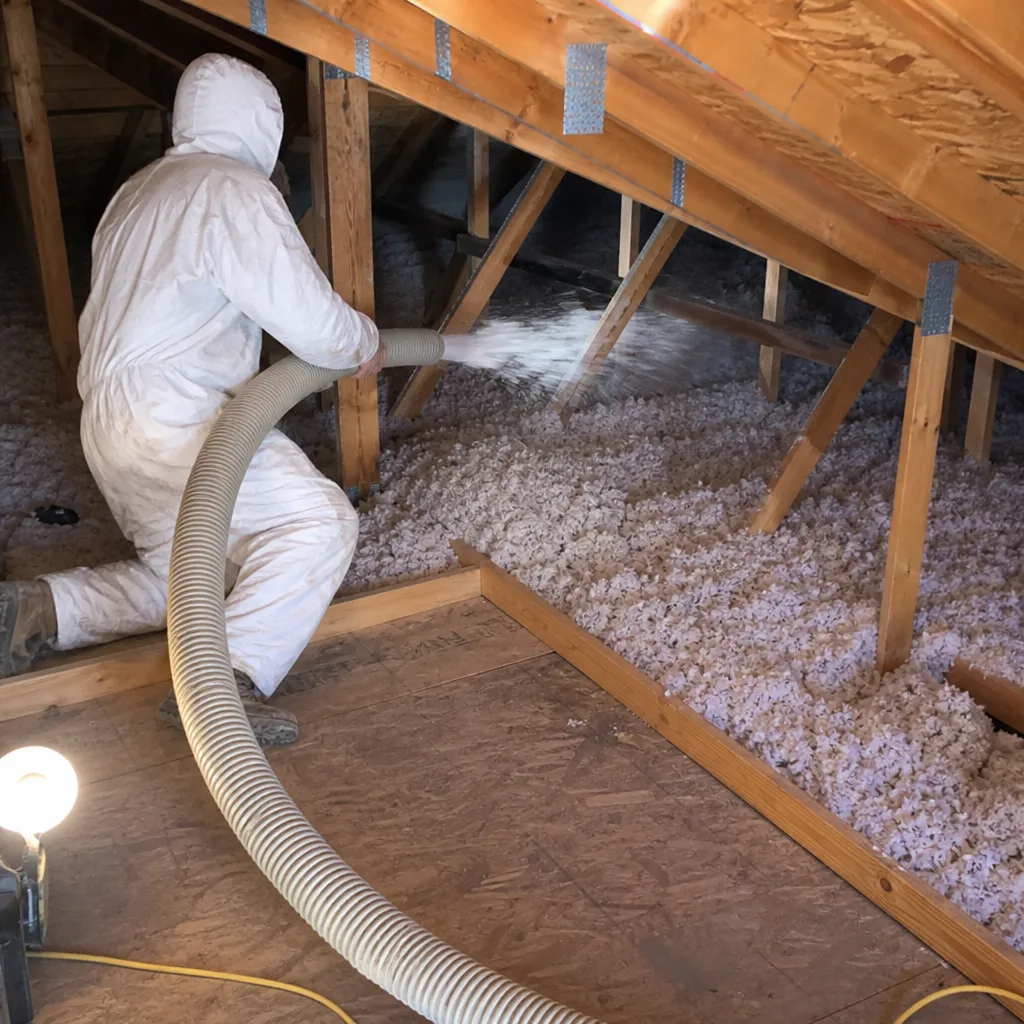
Second, the dust. Desert dust settles into the attic over time and compacts into the top layer of blown-in material, reducing its effective depth by half an inch to an inch over a decade. For homeowners dealing with spray foam insulation in Enterprise, the closed-cell variety handles both problems, since it seals the cavity and doesn’t settle. If your attic doesn’t need a full spray-foam job, a top-off using a product like Owens Corning or GreenFiber brings you back to spec without the cost of a full replacement.
Common Mistakes to Avoid
- Blaming the HVAC first. In our experience across Enterprise, seven in ten “failing AC” calls trace back to attic insulation, not the unit. Get the attic checked before you approve equipment work.
- Adding insulation without air sealing. Topping off insulation over unsealed bypasses is throwing money into the attic. The air leaks squeeze the R-value and the bill barely moves.
- Buying an R-value number without checking the install. A contractor can install R-49 rated material you paid for, but if it’s compressed or poorly distributed, you’re getting R-20 performance. Check coverage, not just the spec sheet.
- Ignoring pest damage. Topping off fiberglass over rodent contamination is a health and air-quality problem. Remove first, then re-install.
- Assuming a decade-old installation is still performing. In Enterprise’s climate, blown-in fiberglass loses meaningful performance within 10-15 years. Ten-year-old insulation deserves a re-inspection even if it was installed well.
- Buying the cheapest quote. Ask for a written price before work starts, ask whether air sealing is included, and ask who is coming to the door. Cheap quotes that skip air sealing aren’t cheap in the end.
- Trying to measure R-value from the hatch alone. Depth of insulation at the hatch doesn’t reflect the average across the attic. Only a full walk of the space gives you a real read.
When to Call a Professional
Some signs are DIY-diagnosable and some aren’t. Call a professional when you find: pest damage or contamination in the attic, insulation that’s clearly below the joists throughout the attic, a ceiling that’s sagging or a vapor barrier that’s torn, or any pattern of bills and temperatures that says “insulation is the problem” but you want it verified before spending money. Also call if the attic hatch hasn’t been opened in years and you’re not sure what’s up there. Aspen Attic Insulation Enterprise offers free estimates across Enterprise. Every estimate comes with a written price before any work starts, so you know exactly what the fix costs before you commit. Call (844) 761-9996 and a live person will answer, day or night. When we schedule your visit, we’ll send your technician’s name and photo ahead of time, so you know exactly who’s knocking on the door.
Frequently Asked Questions
The three most common signs are a cooling bill that climbs 15% or more year over year with no rate change, rooms that run five or more degrees hotter than the thermostat setting, and an HVAC system that runs more than 16 hours a day in July. A ceiling temperature probe with a $12 infrared thermometer often confirms the pattern in 20 minutes. If you’re seeing two of those three, call (844) 761-9996 for a free estimate before you spend money on HVAC repair.
Attic insulation upgrades in Enterprise typically run $1,400 to $3,200 for a standard 1,800-square-foot home. That range covers removal of failed material if needed, air sealing, and blown-in installation at R-38 to R-49. Spray foam insulation runs higher, often $3,000 to $6,500 depending on the square footage and whether you’re doing the whole attic or targeted areas. Duct sealing, if that’s what’s actually wrong, runs $400 to $900. Call (844) 761-9996 and we’ll deliver a written price before any work starts.
Blown-in fiberglass insulation in Enterprise lasts 10 to 15 years before settling and dust compaction meaningfully reduce its R-value. Spray foam holds its performance longer, often 20 years or more, because it doesn’t settle. Even well-installed blown-in material deserves a re-inspection at the 10-year mark in our climate, given the extreme summer heat and monsoon moisture cycling. Call (844) 761-9996 if your home is older than that and you haven’t had the attic checked.
Top-offs and repairs are almost always cheaper than a full replacement, usually $700 to $1,500 versus $1,400 to $3,200 for a full job. The exception is contamination, pest damage, or widespread moisture intrusion, which requires removal first. A free estimate is the fastest way to know which side of that line you’re on. Call (844) 761-9996 and a technician can diagnose it in one visit.
Not with certainty from the bill alone, but the pattern narrows it fast. A bill that climbs gradually year over year alongside even temperature shortfalls across the whole house points to insulation. A sudden spike with a system that won’t hold temperature at all points to HVAC. One or two rooms dramatically worse than the rest points to ducts. An on-site visit is what confirms it. Call (844) 761-9996 to schedule a free diagnostic estimate.
You’ll receive your technician’s name and photo before the visit, and they’ll arrive in a marked uniform with a photo ID badge. If anyone else ever arrives, the visit is free and we make it right. Every job carries a written price before work begins and is covered by our 365-Day Done Right Promise, which covers labor and materials for a full year, with a free second visit if the repair fails. Call (844) 761-9996 to book an estimate and you’ll see the protocol in action.
The Bottom Line
Failing attic insulation in Enterprise is a slow-moving problem, and that’s what makes it expensive. The bill climbs 15% a year, rooms run five degrees hot, the AC runs 16 hours a day, and most homeowners spend $3,000 on the wrong repair before they check the attic. Two months of utility bills, a $12 infrared thermometer, and a look through the attic hatch will tell you most of what you need to know. If the pattern fits, the fix usually costs less than the wrong repair it replaces. And when you call, you’ll know exactly who’s coming and exactly what it costs before we start. Free estimates across Enterprise at (844) 761-9996.
Written by the team at Aspen Attic Insulation Enterprise.