
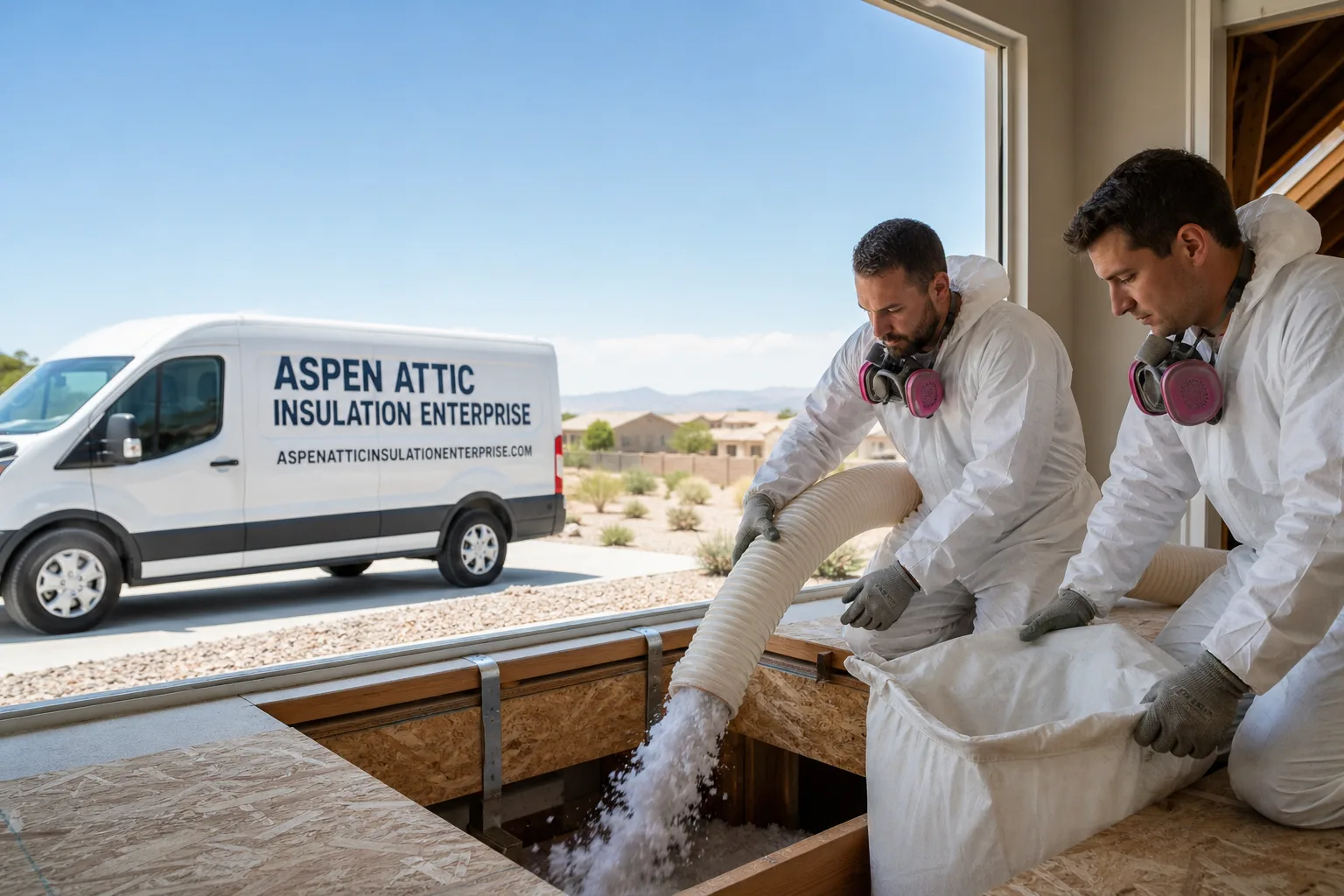
What It Costs to Insulate a House in Enterprise, NV - and Which Zone to Do First
Insulating a whole house in Enterprise typically runs $1,800-$7,500 depending on how many zones you treat. The number that actually matters is smaller: most 1990s and 2000s two-story stucco homes here need the attic floor done first ($950-$2,400), because settled builder-grade fiberglass is the biggest single heat leak in a Mojave Desert house. Call (844) 761-9996 for a free written estimate that breaks your house into zones and prices each one before anyone touches a ladder.
We’re Aspen Attic Insulation Enterprise, and we do this work every week in this city. What follows is a zone-by-zone cost map, not a single average, because a single average is what gets homeowners in Enterprise to overpay in one place and under-treat the spot that’s costing them $80 a month.
Why “Insulating a House” Is a Misleading Search in Enterprise
Type “cost to insulate a house” into Google and you’ll get a national average somewhere between $1,500 and $6,000. That number is honest and useless at the same time. It blends a Michigan attic with a Florida wall cavity with an Enterprise roof deck sitting under 110°F summer sun.
Your house isn’t one envelope. It’s a stack of separate zones, and in Enterprise they fail at very different speeds:
- Attic floor - highest heat gain, fastest payback, most urgent in almost every home here.
- Radiant barrier under the roof deck - cuts attic temps that routinely push past 150°F.
- West- and south-facing wall cavities - the sun-facing walls that bake from 2 p.m. to sunset.
- Duct surroundings and crawl space - where cooled air leaks before it reaches a vent.
Treat them in that order and you spend less and feel more. Treat them out of order and you pay for wall insulation while the attic is still cooking your ductwork. Our technicians have up to 24 years of experience doing exactly this sequencing, and we’ll tell you plainly which zone is bleeding money first.
Zone-by-Zone Cost Map for an Enterprise Tract Home
Here’s the actual pricing we quote in Enterprise, line by line. Ranges reflect square footage, current R-value, and access difficulty - a two-story stucco build costs more to reach than a single-story ranch.
| Zone | Typical Cost | What It Fixes |
|---|---|---|
| Attic blow-in re-insulation (existing fiberglass topped up to R-38 to R-49) | $950-$2,400 | Settled, compacted attic insulation - the #1 heat leak |
| Radiant barrier under roof deck | $1,100-$2,600 | Attic temps that spike past 150°F, baking shingles and ducts |
| West/south wall cavity dense-pack retrofit | $1,400-$3,800 | Builder-grade R-13 walls running at roughly 60% of IECC Zone 3B performance |
| Duct wrap and seal in attic | $400-$1,100 | Sweating, leaking ducts running through a 150°F attic |
| Spray foam for rim joists or attic transition gaps | $600-$1,800 | Air infiltration at joints and framing gaps |
| Full four-zone whole-house scope | $1,800-$7,500 | Complete sequenced envelope |
Every one of these comes with a written price before we start. Not a range scrawled on a clipboard - a document you keep, matched against the actual scope of work.
The Wall Cavity Problem Nobody Talks About in Enterprise
Enterprise boomed in the 1990s and 2000s. Wood-frame stucco construction went up fast, and the walls were insulated to whatever the builder’s minimum was at the time - usually R-13 fiberglass batts. IECC Zone 3B wants more. Those original walls are performing at roughly 60% of where code-minimum sits today, and in a house facing a west wall that takes full afternoon sun in July, that gap shows up on your bill every single month.
A wall retrofit isn’t a cosmetic upgrade. It’s a code-gap closure. And here’s the part that matters: you don’t have to open your drywall to do it. Dense-pack insulation - loose fibers blown into the closed wall cavity under pressure until they fill every gap - can go in through small exterior penetrations. On a stucco house, that means drilling the stucco or entering through the wall’s exterior face, and the two approaches finish very differently.
Our technicians assess which approach preserves your stucco finish before we drill anything, and we quote both options in writing so you can choose. That’s the kind of decision that should be made with a document in front of you, not a verbal “we’ll figure it out.”
Sequenced, Not One Visit - and We Put That in Writing Too
Whole-house insulation is phased work. We recommend attic first because it’s the fastest payback in this climate, then duct wrap, then walls, then crawl space if your home has one. You don’t have to do all four at once. You shouldn’t feel pushed to.
What we provide is a written multi-phase plan - each zone priced separately, each with its own scope - so you can budget across seasons and knock out phase two next year without re-quoting anything. If a company quotes you a single lump number for “the whole house” on day one, ask them which zone they’re starting in and why. That question separates a specialist from a sales call.
One more thing we do differently: one background-checked, photo-badged technician assesses the entire house on the first visit and produces a room-by-room written scope. You’ll get that technician’s name and photo before they knock. If anyone else shows up, the visit is free. The person who assesses your house is the person who works on it - not a sales rep followed by a rotating crew.
What Actually Shows Up in Enterprise Attics
The original attic insulation in these homes is often a thin layer of blown fiberglass that has settled to R-8 or less. The desert heat bakes it into a hard crust. Meanwhile the AC ductwork runs through the same attic, sweating and leaking into air that’s already hot enough to warp a plastic storage bin.
That’s the first-hand detail a national average can’t tell you: in a 1990s two-story stucco home on an Enterprise cul-de-sac, the attic is almost always the answer before the walls. Wall cavities matter. The attic is where the money goes.
When we re-insulate an attic, we’re typically blowing in Owens Corning or GreenFiber loose-fill (loose fibers blown into the attic cavity to fill every gap around joists and penetrations) to reach R-38 to R-49. For radiant barrier work in these sun-facing roofs, the goal is rejecting the solar load before it ever converts to heat. We carry materials from eight industry-leading brands - Owens Corning, Johns Manville, Knauf, Rockwool, CertainTeed, Icynene, Demilec, and GreenFiber - and match the product to the zone, not to whatever’s left on a shelf.
If you want the full picture on how we approach the install side, our Insulation Installation in Enterprise page walks through the process. Start from our home page if you’re brand new to this and want to see how we operate.
What the Written Price and Guarantee Actually Cover
Every job here gets a written price before work starts, no exceptions, and the whole thing is backed by our 365-Day Done Right Promise - 365 days, in writing, covering labor and materials. If something fails, we come back. Free second visit. That’s the entire guarantee, stated plainly.
A live person answers our phone 24/7. No voicemail loop, no callback window that swallows your afternoon. Estimates are free.
FAQs
Whole-house insulation in Enterprise runs $1,800-$7,500 for a full four-zone scope, and most homeowners start with attic re-insulation alone at $950-$2,400. The exact number depends on attic square footage, wall cavity access on your stucco, and whether ducts need wrapping. Call (844) 761-9996 for a free written estimate broken out by zone.
For most Enterprise homes, topping up and re-blowing over prepared existing insulation is cheaper than a full removal, and it’s usually the right call - settled fiberglass at R-8 can be brought to R-38 to R-49 without hauling everything out. Full removal only makes sense when the old material is contaminated or water-damaged. Call (844) 761-9996 and we’ll tell you which case you’re in before quoting.
Yes - dense-pack insulation goes into closed wall cavities through small exterior penetrations, so your drywall stays intact. On stucco homes we assess whether drilling the stucco or entering from the exterior face preserves the finish better, and we quote both options in writing before drilling. Call (844) 761-9996 to schedule the assessment.
Most homeowners we serve in Enterprise see a meaningful drop in summer cooling costs after attic re-insulation plus duct wrap, though the exact savings depend on the starting R-value and how leaky your ducts are. The attic-first sequence exists because it produces the fastest payback in a 104°F+ climate. Call (844) 761-9996 for an estimate that shows what your specific zones need.
Ready to know what your house actually needs? Call (844) 761-9996 for a free estimate. A background-checked, photo-badged technician assesses every zone in one visit and hands you a written room-by-room scope with a clear price - no obligation, no surprises on the invoice.
Written by the team at Aspen Attic Insulation Enterprise, serving Enterprise, NV.
What Our Customers Say
"The estimate was clear on R-value and cost per square foot. No add-ons."
- Omar N."Blown in cellulose up to R-49 in the attic. Tech badged in at the door and measured the depth with a ruler before and after. Upstairs bedrooms stopped being an oven."
- Fran T."Vetted crew, which I liked. Installed baffles at the eaves so the vents stay clear."
- Sonia B.