
Icynene Attic Insulation in Enterprise: A Homeowner’s Guide
Icynene open-cell foam expands at roughly 100:1. That single ratio explains almost everything about how an Icynene job goes right or wrong. If the technician misjudges the yield by 10%, your attic ends up with either a thin spot that becomes a thermal bridge or a foam mass thick enough to block soffit ventilation. Neither problem shows up on a walk-through for months. In Enterprise, where summer attic temperatures climb past 150°F, those hidden failures cost you real money on every cooling bill. This guide is about vetting the person spraying the foam, not the foam itself.
If you’d rather not spend your week interviewing contractors, call us at (844) 761-9996 and we’ll walk you through what an Icynene job in your attic should look like.
Why Icynene Demands a Certified Applicator, Not Just a Spray Foam Guy
Icynene’s slow-rise, water-blown formula behaves differently from the fast-set foams most contractors train on. It needs to be applied in passes, at specific thicknesses, with the substrate temperature and ambient humidity factored in. Icynene runs its own certified applicator program for exactly this reason, and general “spray foam” training doesn’t substitute for it. When you’re comparing contractors in Enterprise, the certification question should come before the price question.
Here’s what we mean by installer-dependent. A fast-rise closed-cell foam is more forgiving; it kicks quickly and a small yield error shows up as an obvious thick patch. Open-cell Icynene rises gradually, so a technician who hasn’t done many Icynene jobs can keep spraying past the correct pass depth without noticing. By the time the foam cures, you’ve got a section that’s over-applied and denser than spec, or an under-applied area that never reaches the target R-value. Only close pass-by-pass monitoring catches it in the moment.
In our experience, the certification is the floor, not the ceiling. A certified applicator who has sprayed dozens of Enterprise attics knows how the local heat and dry air affect cure times, and they adjust their passes accordingly. Ask any contractor three things:
- Their Icynene applicator certification number, and whether it’s current.
- How many Icynene jobs they’ve completed in the past 12 months, not total spray foam jobs.
- Whether the technician assigned to your attic is the certified one, or a helper doing the spraying under remote supervision.
If a contractor can’t answer all three cleanly, they’re not the right installer for this product.
Open-Cell Icynene in a Hot-Dry Climate: The Ventilation Question
This is where most Icynene advice online gets your climate wrong. Open-cell foam is vapor-permeable; it lets moisture move through. In a cold climate where you heat for eight months, that’s usually a benefit because it lets the assembly dry toward the interior. In Enterprise, you’re cooling for roughly 10 months a year. The vapor drive in a hot-dry climate comes from the outside in during the day and reverses at night, and a permeable foam in the wrong assembly can trap moisture against the roof deck when the temperature swings.
That doesn’t make Icynene a bad product for Enterprise attics. It makes the assembly design matter as much as the foam. A proper Icynene installation in Enterprise usually involves one of these approaches:
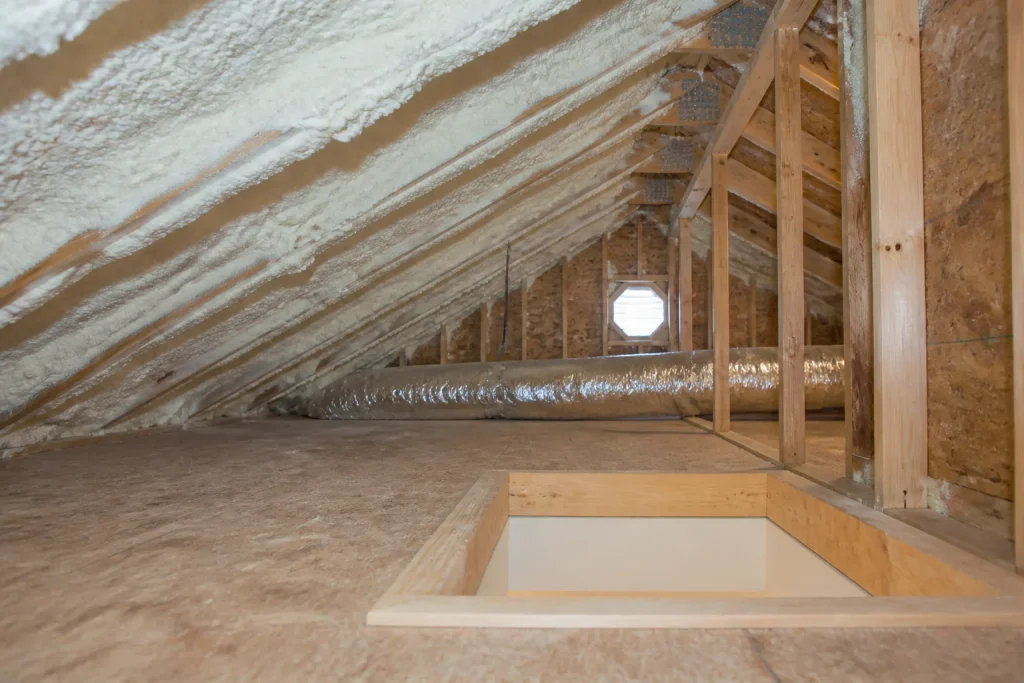
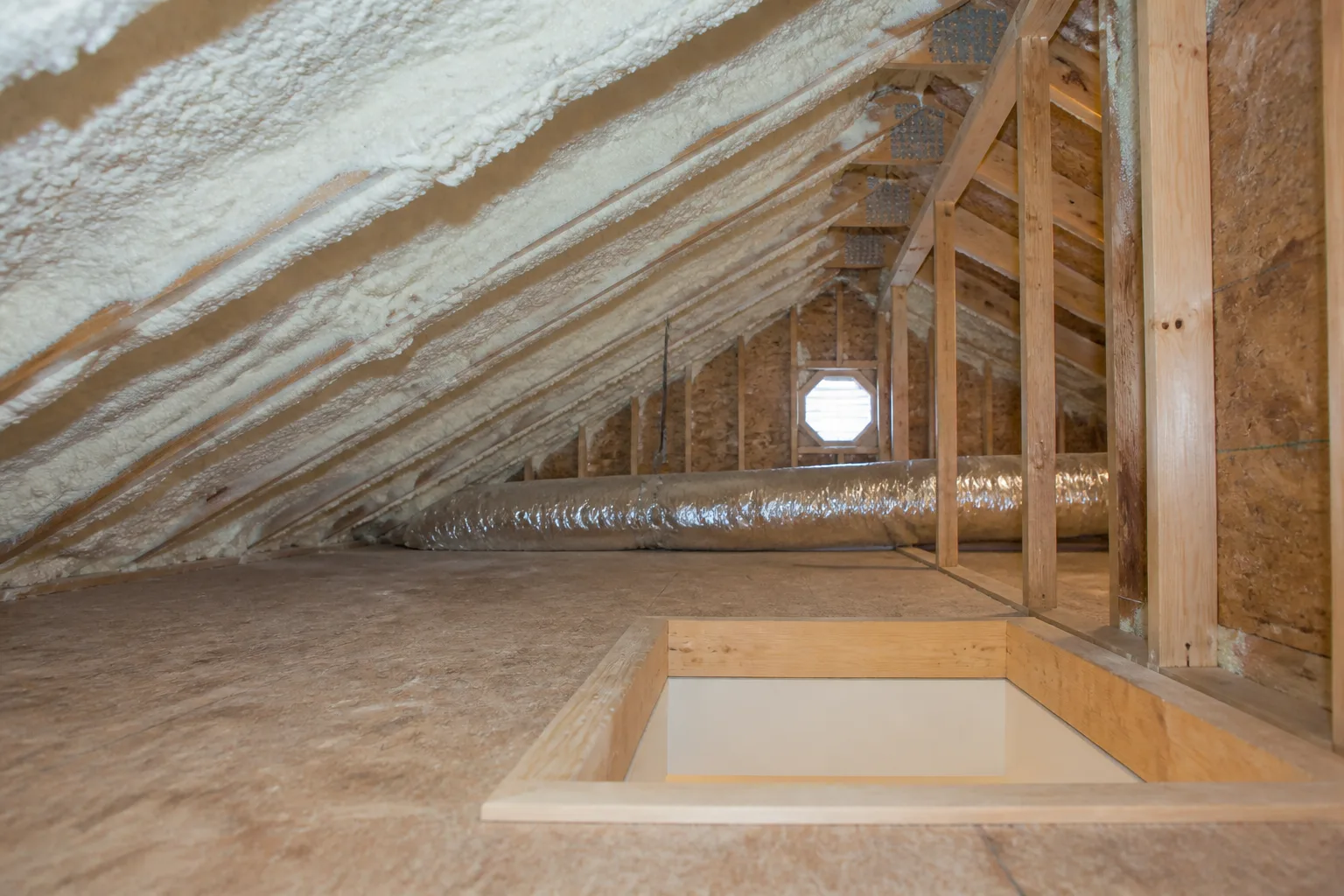
- Sealed, unvented attic: foam applied to the roof deck and gables, with soffit vents blocked and the attic brought inside the conditioned envelope. This is the more common choice for open-cell Icynene and works well when applied at the correct thickness.
- Vented attic with foam on the ceiling plane: foam on the attic floor with ventilation left intact. Less common with open-cell foam but sometimes correct for older Enterprise homes with no HVAC equipment in the attic.
- Hybrid approach: foam in the transition zones and blown-in over the flat ceiling, which is where product choice matters. We keep Knauf and CertainTeed blown-in options on hand for exactly these mixed assemblies.
The point is that an installer who recommends the same Icynene setup for every attic hasn’t thought about your house. Ask why they’re choosing the assembly they’ve proposed, and what it does to the vapor profile in July.
Off-Gassing and Re-Entry: What Your Contract Should Say in Writing
Icynene is one of the lower-VOC spray foams on the market, but “low” isn’t “none.” Freshly applied foam releases trace compounds as it cures, and the cure window depends on thickness, temperature, and airflow. In an Enterprise attic in July, cure happens fast; in January, it takes longer. The re-entry timeline your contractor gives you should be tied to those conditions, not to a generic “24 hours” printed on a brochure.
What you want in writing, before anyone sprays:
- Expected re-entry time for the specific thickness being installed, in hours, with a note that it may extend in cooler weather.
- Ventilation requirements during cure – how many hours of forced air, whether windows should be open, and whether HVAC should be off or running.
- The product data sheet and safety data sheet for the exact Icynene product being installed, attached to your contract.
- Who to call if you smell something unusual past the stated window, and what the contractor commits to doing about it.
This is not a place to accept a verbal “you’ll be fine by tomorrow.” If the contractor won’t put the re-entry terms in writing, they’re telling you how they handle everything else.
Questions to Ask Before Anyone Sprays Icynene in Your Attic
We’ve been called out on more than one Enterprise job to assess a foam install another contractor walked away from. The pattern is usually the same: no certification paperwork, no yield log, and an invoice with no name attached to it. Here’s the short list we’d use if we were hiring this out ourselves.
- What’s your Icynene certification number, and can I see the card? It’s a simple ask. A certified applicator carries it or can produce it from their office.
- Can I see your mixing ratio and yield logs from your last three Icynene jobs? A serious applicator logs the ratio and the yield for each job. It’s how they know what they actually installed.
- Do you carry Icynene-specific product liability coverage? General contractor liability is not the same thing. If the foam fails, the coverage you need is the coverage tied to the product.
- Who is the certified technician showing up, and what’s their name? A professional should be able to tell you before the day of the job.
- What does your written guarantee cover if a soft spot or a thermal bridge shows up next summer? The answer should be specific and in writing.
Anyone who gets defensive at question one or two isn’t the right person for this product. Asking costs you nothing and screens out most of the risk.
How We Document Icynene Jobs in Enterprise
The brand on the drum matters less than the record of what happened in your attic. Here’s how we handle an Icynene job, and why each step exists.
Before the visit, you get the name and photo of the technician assigned to your attic, along with their ID badge details. When they arrive, they show that badge at the door in a marked uniform. If someone else shows up, the visit is free. We also send a written price before any work begins, covering labor and materials, so there’s no invoice surprise after the foam has cured.
During the install, the technician logs the mixing ratio and the pass thicknesses. We photograph the attic before, during, and after application, which gives you a visual record of what the assembly looked like at every stage. After the job, those photos go on file with your written price and your written guarantee.
What the 365-Day Done Right Promise covers matters here: if expansion inconsistencies show up later, such as a soft spot, a thermal bridge, or a blocked soffit vent that didn’t surface on the walk-through, we make it right. That’s a free second visit, covered in writing for 365 days on labor and materials. If a repair fails, the return visit is on us. The point of the guarantee is that Icynene’s installer dependence is exactly why you want a year of protection against anything the install missed.
Our technicians have up to 24 years of experience, and the experienced ones are the ones who notice a yield problem mid-pass instead of three months later. That’s the whole reason we put the paperwork around it.
The Bottom Line
Icynene is a genuinely good product for an Enterprise attic, but its slow-rise behavior means the outcome lives almost entirely in the hands of the person spraying it. Certified applicator over certified product. A written assembly plan that accounts for hot-dry vapor drive over a generic recommendation. Re-entry terms and yield logs in writing, before the first pass. If you’re in Enterprise and need help, Aspen Attic Insulation Enterprise offers free estimates: call (844) 761-9996 and we’ll walk you through what your attic actually needs.
Related services in Enterprise: if you’re weighing Icynene against other options, our attic insulation in Enterprise page covers the assembly basics, the spray foam insulation in Enterprise page goes deeper on product choices, and the blown in insulation in Enterprise page explains where a hybrid approach beats full foam. You can also start at our Aspen Attic Insulation Enterprise home page.
Frequently Asked Questions
Is Icynene safe to be around right after installation? Yes, once the cure window has passed. That window depends on thickness, temperature, and airflow, so your contract should state a specific re-entry time in hours and note that cooler weather extends it. Ask for the safety data sheet for the exact product being installed, and don’t accept a verbal timeline. If you want us to review a proposed install in Enterprise, call (844) 761-9996.
Is open-cell Icynene a good choice for an Enterprise attic? It can be, provided the assembly is designed for a hot-dry cooling climate. Open-cell foam is vapor-permeable, which matters more in Enterprise than in a heating climate. The right answer is usually a sealed, unvented attic with the foam applied to the roof deck at the correct thickness, but the assembly depends on your home. A contractor who recommends the same setup for every attic hasn’t looked at yours.
What’s the difference between an Icynene-certified applicator and a spray foam contractor? Icynene runs its own certified applicator program because its slow-rise formula needs specific pass depths and mixing ratios. General spray foam training doesn’t substitute. Ask for the certification number, recent Icynene job logs, and whether the certified technician is the one actually spraying. Call (844) 761-9996 for a free estimate and we’ll send you the technician’s name and photo before the visit.
What should I ask before I hire someone to spray Icynene in my attic? Ask for the certification number, mixing ratio and yield logs from recent jobs, Icynene-specific product liability coverage, who the certified technician is, and what their written guarantee covers if expansion inconsistencies surface later. Anyone who gets defensive at the first two questions isn’t the right installer for this product. Call (844) 761-9996 to get a written price before any work begins.
When to Call a Pro
If you’re reading this because you found a soft spot, a cold wall, or a draft that wasn’t there last summer, that’s a call-a-pro moment, not a watch-and-wait moment. Icynene failures hide behind the cured surface, and the earlier someone with experience looks at it, the cheaper the fix. Same goes for anyone evaluating a spray foam quote: the questions on this page are free to ask, and any contractor who can’t answer them is telling you something.
Call Aspen Attic Insulation Enterprise at (844) 761-9996 for a free estimate. A live person answers, every time, and you’ll get a written price before any work starts.
Written by the team at Aspen Attic Insulation Enterprise.
Need Insulation Help?
Call Aspen Attic Insulation Enterprise - licensed & insured, here with fast after-hours help in Enterprise.
(844) 761-9996