
CertainTeed Attic Insulation in Enterprise: A Homeowner’s Guide
Blown-in insulation in an Enterprise attic can shed up to a full R-value per year to thermal settling when the initial density isn’t installed to spec. CertainTeed’s InsulSafe SP is engineered for high-density machine installation; most competing loose-fill products aren’t. That difference decides whether your attic holds its rating for two summers or ten, and in a climate that swings from 45°F nights to 115°F afternoons, it’s the whole ballgame. If you’d rather not sort through bag charts yourself, call (844) 761-9996 and we’ll walk your attic with you.
What “Settled R-Value” Means and Why Enterprise Attics Get Hit Harder
R-value is a measurement of resistance to heat flow. The number on the bag is a lab figure taken under controlled conditions. In a real attic, loose fibers compress under their own weight, under vibration from wind and HVAC equipment, and under the constant cycle of daytime heating and nighttime cooling. Every inch of lost thickness is lost R-value, and once it’s gone, no amount of thermostat discipline gets it back.
Manufacturers publish settling projections using a national climate average. Enterprise doesn’t live in that average. An attic here can hit 140°F or more on a July afternoon and drop into the 50s on a January night. That daily expansion and contraction works loose-fill like a bellows, accelerating compaction well past what a cooler market would see. We’ve pulled attic hatches in Aspen-area neighborhoods and found blown fiberglass that started at R-38 sitting closer to R-28 after seven or eight seasons. The homeowner never touched it. It just settled.
This is why we say the installation density matters more than the brand badge on the bag. A product rated for high-density installation, installed at that density, resists settling in ways standard loose-fill cannot.
CertainTeed InsulSafe SP vs. Standard Blown Fiberglass
InsulSafe SP is a fiberglass blowing wool formulated for pneumatic machines calibrated to a specific density target. Standard blown fiberglass is often installed at whatever density the machine happens to produce, which is usually lower than the manufacturer’s optimal spec. Lower density means more air pockets, more settling, and a shorter useful life.
Here’s what to compare before you sign anything:
- Density spec: InsulSafe SP is designed for high-density installation. Ask your contractor for the installed density in pounds per cubic foot, and confirm it matches the manufacturer’s published chart for your target R-value.
- Bag coverage: Every CertainTeed product ships with a coverage chart showing bags-per-square-foot at each R-value. A contractor who can’t produce that chart for your job is guessing.
- Invoice line items: Your invoice should state the product name, the number of bags used, the installed depth in inches, and the target R-value. If any of those are missing, you have no way to verify the job was done to spec.
We stock CertainTeed alongside Owens Corning and Johns Manville because different attics call for different products. A cathedral ceiling with tight bays may want something else entirely. But for a standard vented attic in Enterprise’s heat, high-density CertainTeed blown fiberglass is one of the most settling-resistant options on the market.
Nevada Energy Code R-38: What It Actually Requires
Nevada’s energy code calls for R-38 in a typical vented attic. In plain terms, that’s the minimum thermal resistance your insulation needs to hit between the living space and the attic air. What most homeowners don’t realize is that R-38 isn’t a product you buy; it’s a result you achieve through the right product at the right depth.
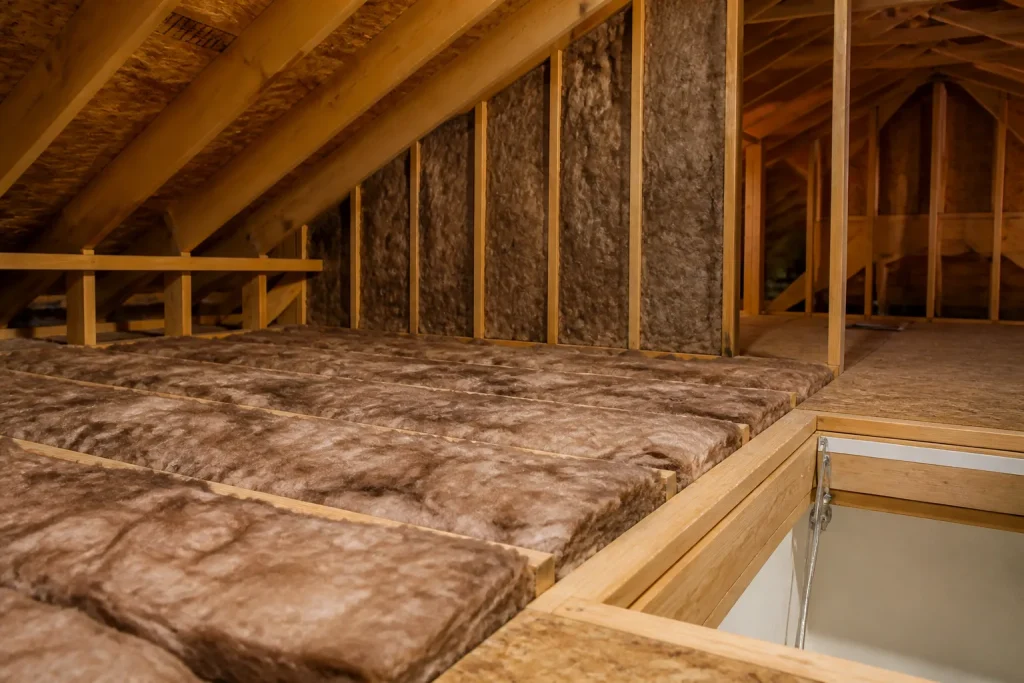
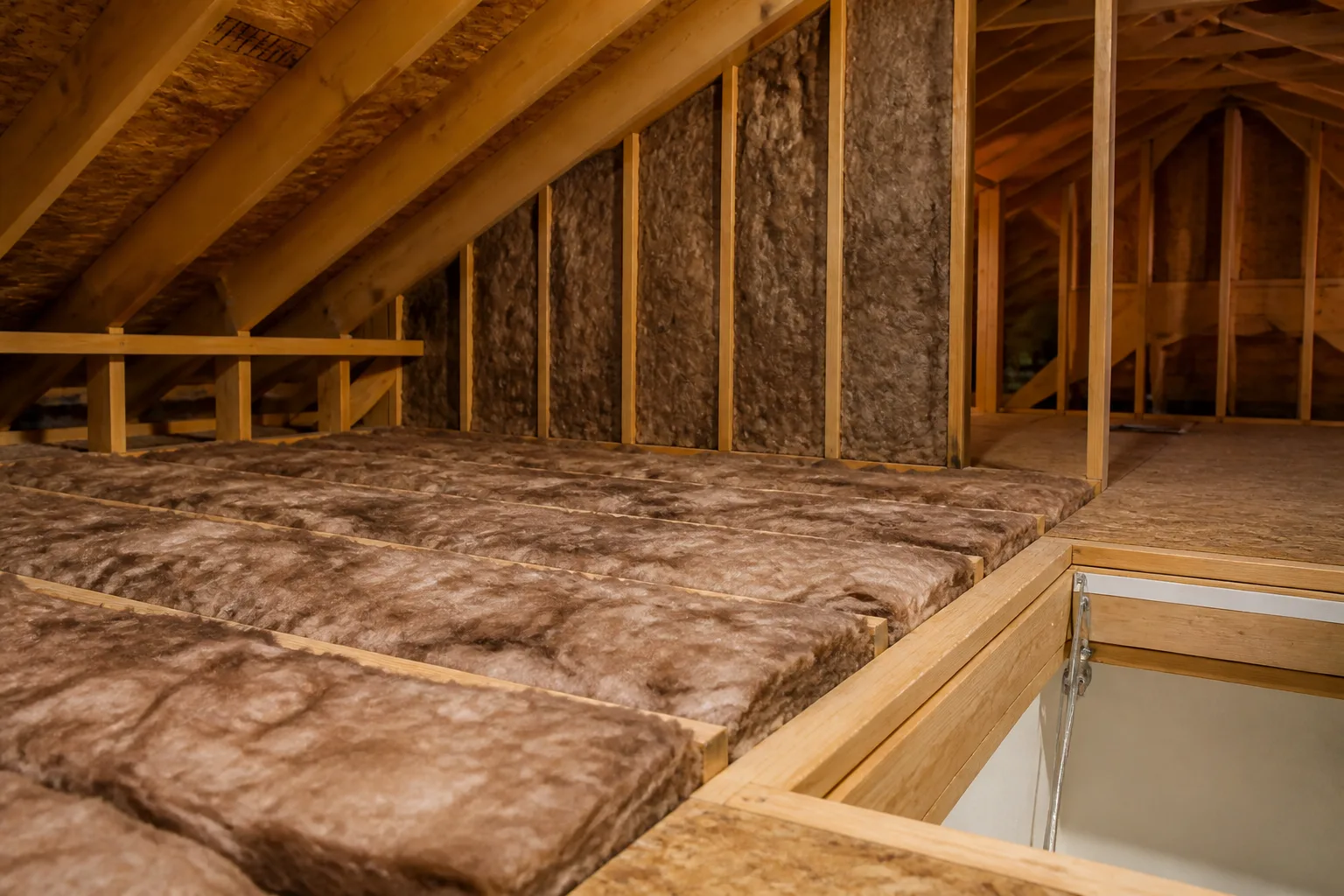
With CertainTeed InsulSafe SP installed at the manufacturer’s specified density, a standard truss attic generally reaches R-38 at a depth in the range of 13 to 15 inches, depending on the exact product variant and machine calibration. Your contractor should confirm the target depth for your specific product and attic configuration before the first bag goes in. “A foot or so” is not a depth spec.
Two things we check on every CertainTeed install before we blow a single ounce:
- Air sealing around can lights and penetrations. Unsealed recessed fixtures let conditioned air escape into the attic, which undermines the insulation above them. We seal them first, then insulate over.
- Rafter vents. Baffles at the eaves need to stay clear so the attic can breathe. Blowing insulation into a blocked baffle traps moisture and voids the whole assembly.
After the job, we photograph the depth gauges we set at multiple points across the attic. That gives you a visual record of what was actually installed, not just a number on a work order. If you want that same documentation standard on your job, our attic insulation in Enterprise page spells out the full process.
Decoding the Warranty: Manufacturer vs. Installer
Here’s where homeowners get tripped up. CertainTeed’s manufacturer warranty covers defects in the product itself. It does not cover installation errors. If your insulation was blown too thin, poorly sealed, or installed over blocked vents, the manufacturer isn’t on the hook. The installer is.
That’s why you want both warranties in writing, and you want to read what each one actually says:
- Manufacturer warranty: Covers product defect. Ask for the written terms and the length of coverage specific to your product.
- Installer guarantee: Should cover labor and materials for a defined period. Ours is the 365-Day Done Right Promise, which covers the full job in writing for a year, with a free second visit if anything we installed fails.
- Written price before work begins: Every job we do comes with a written price upfront. No surprises after the truck leaves.
We’ve seen attics in Enterprise where the product was fine but the install was rushed. The homeowner had a CertainTeed bag label and a settled, underperforming attic. The brand did its job. The installer didn’t.
Why We Insist on CertainTeed for the Attics That Call for It
We work with eight material brands because no single product is right for every attic. GreenFiber cellulose has its place. Knauf and Owens Corning make excellent products. But when we’re looking at a standard vented attic in Enterprise’s climate and the homeowner wants maximum settling resistance from a blown fiberglass product, CertainTeed InsulSafe SP is the one we reach for.
The physics make the case. High-density installation resists compaction. Compaction control preserves R-value. Preserved R-value means the number on your energy bill stays where you expect it. That’s not brand loyalty. That’s reading the spec sheet.
Our technicians have up to 24 years of experience, and we’ve all learned the same lesson: the cheapest blown insulation is the one you replace first. If your attic needs spray foam rather than blown fiberglass, we’ll tell you. Our spray foam insulation in Enterprise page covers when that’s the right call. For many homes, though, high-density blown CertainTeed is the most cost-effective path to code compliance and a cooler house.
When to call a pro: If your attic has any recessed can lights near the insulation line, if the rafter vents look blocked, or if you’ve never had the depth measured, don’t guess with a rented machine. Those details decide whether the warranty holds. Call (844) 761-9996 and we’ll take a look.
Related services in Enterprise: blown in insulation in Enterprise and our home page cover the full range of what we handle.
The Bottom Line
CertainTeed InsulSafe SP is worth specifying in Enterprise because it’s built for the installation density that resists settling in a climate with 70-degree daily swings. But the product only performs if the contractor installs it to spec, seals the air leaks, clears the vents, and documents the depth. Ask for the bag coverage chart. Ask for the installed density. Ask for the photo of the depth gauge. And make sure the installer’s written guarantee covers what the manufacturer’s warranty doesn’t.
If you’re in Enterprise and need help, Aspen Attic Insulation Enterprise offers free estimates. Call (844) 761-9996 for a written price before any work starts, a technician’s name and photo sent to you before the visit, and a 365-Day Done Right Promise backing the job.
Frequently Asked Questions
Most standard vented attics in Enterprise land in a range of roughly $1,400 to $2,800 for blown-in fiberglass reaching R-38, depending on square footage, existing insulation condition, and how many air-sealing details are involved. Call (844) 761-9996 for an exact written quote. Estimates are free.
InsulSafe SP is formulated for high-density installation, which reduces settling compared to products installed at lower density. The key is installation density, not the brand alone. Confirm the installed density on your invoice matches the manufacturer’s spec.
With high-density blown fiberglass like InsulSafe SP, a standard truss attic typically reaches R-38 at around 13 to 15 inches of installed depth. Your contractor should confirm the exact target for your product before the job starts.
Sometimes, yes, but only after the existing insulation has been checked for air sealing, moisture, and vent blockage. Adding over blocked rafter vents or unsealed can lights wastes money. A pre-job walkthrough catches those issues first.
Written by the team at Aspen Attic Insulation Enterprise.
Need Insulation Help?
Call Aspen Attic Insulation Enterprise - licensed & insured, here with fast after-hours help in Enterprise.
(844) 761-9996