
Blown In Insulation: Repair or Replace? How Enterprise Homeowners Decide
Most blown-in insulation that looks tired is still doing most of its job. In our experience across Enterprise, the honest answer to repair-or-replace comes down to three numbers: your current R-value, the age of the material, and whether rodents or moisture have gotten into it. You can measure all three yourself with a $4 depth gauge ruler and a flashlight. This guide gives you the diagnostic framework so you can make the call before anyone tries to make it for you.
Start With the Three-Number Test in Your Own Attic
Before you call anyone, get the three numbers. They tell you whether you’re looking at a top-off, a partial repair, or a full replacement, and each one points to a different price. Here’s how to gather them on a Saturday morning in Enterprise.
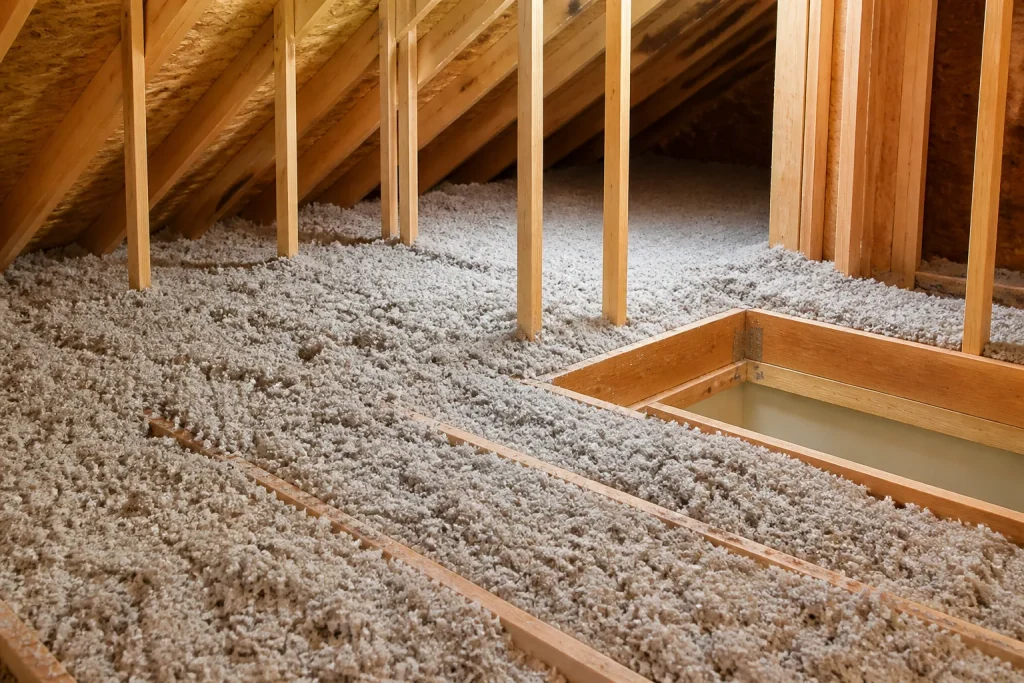
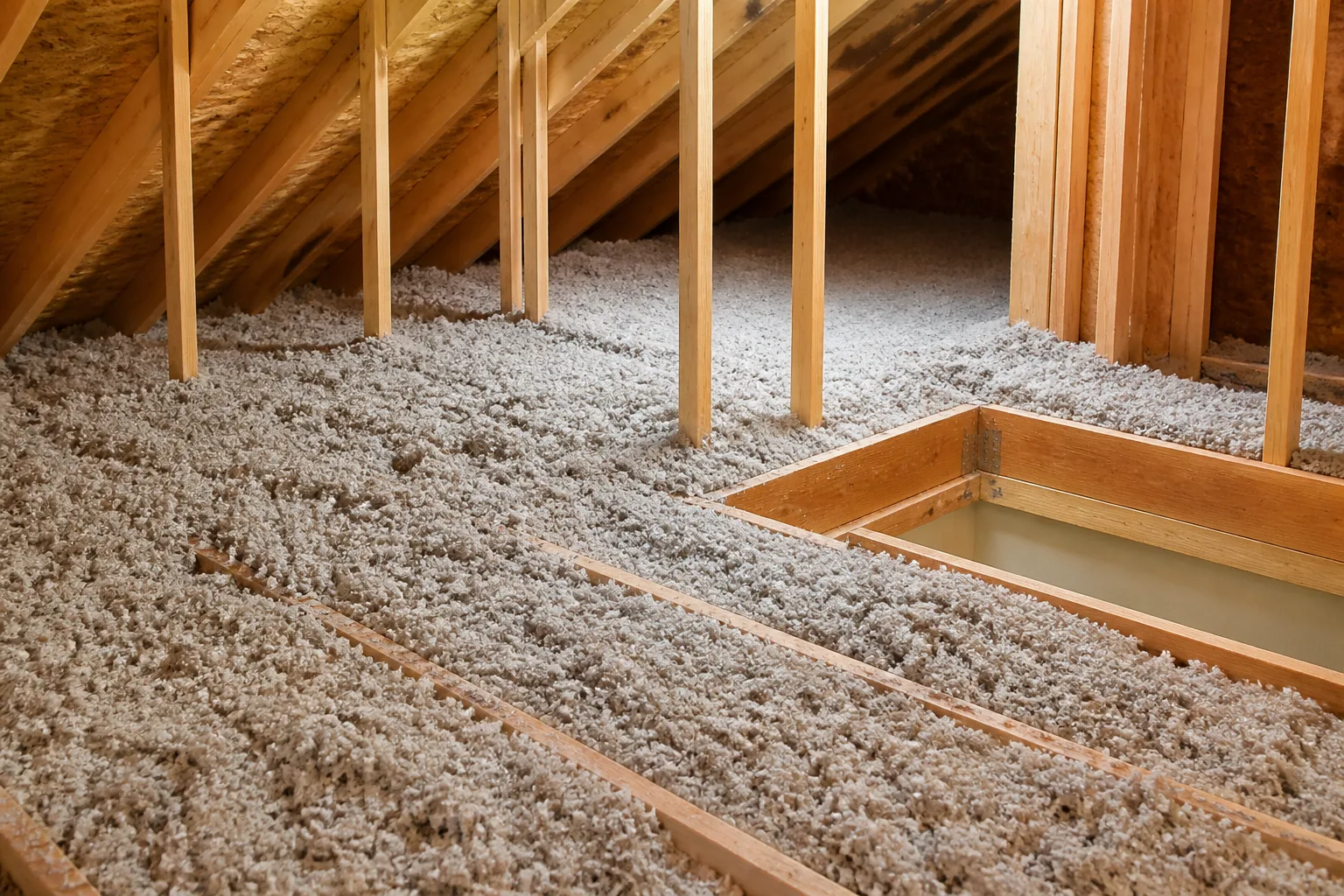
- Measure depth and convert to R-value. Push a cheap depth gauge ruler (any hardware store, about $4) down to the attic floor in five or six spots. Fiberglass blown-in runs roughly R-2.5 to R-3 per inch; cellulose closer to R-3.5. If your average depth is 8 inches of cellulose, you’re at roughly R-28.
- Compare against Nevada’s code minimum. Enterprise attics sit in climate zone 4, and the energy code calls for R-38 minimum in new construction. If your probe math lands under 38, you have room to top off. Well under 25, and you’re losing real money every summer.
- Look for contamination. Rodent droppings, nesting tunnels, urine staining, or damp clumps change everything. Clean insulation can be topped off; contaminated insulation has to come out.
Write those three numbers down. They’re the whole conversation. If you’d rather not crawl into a 130-degree attic in July, that’s fair, and you can reach our Enterprise team here or call (844) 761-9996 for a free attic assessment.
How to Tell Settling, Rodent Damage, and Moisture Apart
Blown-in insulation loses performance for three very different reasons, and each one has its own fix and its own price. Mixing them up is the single most expensive mistake Enterprise homeowners make, because a rodent problem sold as a replacement job is a bill you didn’t need.
- Settling looks even. The material is uniform, just shallower than it was on install day. Loose-fill settles 15 to 20 percent in the first few years, and that’s normal, not a failure. Fix: top off to R-38. Cost typically runs $900 to $1,800 for a standard Enterprise attic.
- Rodent damage is patchy. You’ll see flattened trails through the material, small dark droppings, chewed vapor barrier, and tunneling near the edges and top plates. Fix: remove and dispose of contaminated material in the affected zones, seal entry points, then re-blow those areas. Runs $600 to $1,500 depending on how far the trails go.
- Moisture damage clumps. The material feels heavy, matted, or smells musty, and you may see staining on the rafters or sheathing above. That’s often a ventilation or roof leak issue, and no amount of new insulation fixes it until the source is handled. Fix: correct the moisture source first, then replace the wet sections.
We pulled a job over in the Sunset Ridge area last spring where the homeowner had been quoted a full replacement. Two-thirds of the attic was clean and settled. We sealed the bypasses, removed one contaminated corner, and topped the rest to R-38 for a fraction of the replacement quote. Settling isn’t failure. It’s just math.
When Age Tips the Scale Toward Replacement
Age matters, but not the way most people assume. Cellulose insulation is treated with borate compounds for fire and pest resistance, and those treatments deplete over time, particularly in a hot, dry attic. Material manufactured before 2005 is the practical cutoff. If the stamp on the bag or the install paperwork puts your cellulose in the pre-2005 range and it’s already underperforming, replacement usually makes more sense than another top-off.
Fiberglass ages more gracefully, and we’ve seen 20-year-old fiberglass in Enterprise attics still holding most of its rated value once you account for settling. The real age question is this: has this material been topped off repeatedly without anyone addressing the air sealing underneath? Three top-offs over 15 years with no air sealing is money spent on the wrong fix.
One more local factor. Enterprise sits at the edge of the Mojave, and attic temperatures regularly push past 140°F in summer. That heat load accelerates the breakdown of older cellulose and stresses the vapor barrier faster than you’d see in a milder climate. If you’re weighing a pre-2005 attic in Enterprise, lean toward replacement.
Partial Repair Is a Waste of Money Until You Seal the Bypasses
Here’s the part most estimates skip. Insulation works by trapping air, and air moves. If your attic has open air bypasses, new insulation laid over the top of them does almost nothing, because the conditioned air escapes through the gap regardless of how deep the fluff gets. This is exactly why a blown-in job that looked fine on install day can be running at 60 percent of its rated R-value five years later in an Enterprise attic. The product didn’t fail. Nobody sealed the bypasses underneath it.
The common bypass locations in Enterprise homes:
- Recessed can lights, especially older non-IC-rated fixtures that leak warm air straight into the attic
- Top plates where the wall framing meets the ceiling, often with visible gaps
- The attic hatch or scuttle, which is frequently uninsulated and unsealed
- Plumbing and wiring penetrations through the ceiling plane
- Chimney and flue chases
Any top-off or repair estimate that doesn’t include air sealing is incomplete. Ask specifically what gets sealed before the new material goes down. With the right materials, Rockwool and CertainTeed both make products suited to these gaps, and a proper job starts with the sealing, not the blowing.
What a Written Repair Estimate Should Include
A replacement quote from a competitor typically lists one line: remove old insulation, install new. A repair estimate that actually protects you lists five or six. Before you sign anything in Enterprise, check that the written price covers the following.
- Air sealing scope with the specific bypasses named
- Removal and disposal of contaminated material, with the disposal fee itemized
- The R-value target stated as a number, not “bring to code”
- Material brand and type spelled out, so you know whether you’re getting fiberglass or cellulose and from whom
- What happens if the job fails, in writing, with the covered period and whether labor and materials are both included
Our written price always lands before any work starts, and every repair carries a 365-Day Done Right Promise covering labor and materials, with a free second visit if the repair fails. That’s the standard we hold, and it’s the standard you should ask any contractor to match. The technician who shows up for us is background-checked, arrives in a marked uniform with a photo ID badge, and you get their name and photo before the visit. If anyone else arrives, the visit is free. You can see our full approach to blown in insulation in Enterprise if you want to compare line items.
When to Call a Pro
Three situations warrant a professional before you touch anything. First, any sign of moisture damage or a possible roof leak, since that’s a water problem dressed up as an insulation problem. Second, rodent contamination, which involves safety gear and proper disposal that aren’t worth improvising. Third, anything touching recessed lighting or electrical penetrations in the attic, because you should never seal around a fixture without knowing whether it’s rated for contact with insulation. Our technicians have up to 24 years of experience, and the electrical-adjacent work is exactly where that experience matters.
Related services in Enterprise: if your attic assessment points toward a different material entirely, spray foam insulation in Enterprise seals and insulates in one step, and attic insulation in Enterprise covers the full range of options. If you’re topping off existing fiberglass or cellulose, blown in insulation is the direct path.
The Bottom Line
Get your three numbers first: current R-value from a depth probe, the age of the material, and whether contamination is present. Settling alone means top off. Rodent or moisture damage means targeted removal and repair. Pre-2005 cellulose that’s already underperforming means replacement. And any repair that doesn’t seal the air bypasses first is money thrown at the wrong problem.
If you’re in Enterprise and want a second opinion on a replacement quote, or you’d rather someone else crawl the attic in July, Aspen Attic Insulation Enterprise offers free estimates. Call (844) 761-9996. A live person answers, day or night, and you’ll have a written price in hand before anything starts.
Frequently Asked Questions
Repair when the insulation is clean, under 20 years old, and mostly settled; top off to reach Nevada’s R-38 code minimum. Replace when the material is pre-2005 cellulose that’s already underperforming, or when rodent or moisture contamination affects more than a small zone. Measure your R-value with a depth probe before deciding. Call (844) 761-9996 if you’d like a free check.
Typical repairs run $600 to $1,500 for targeted removal and re-blow in affected zones, and $900 to $1,800 to top off a standard Enterprise attic to R-38. Full replacement with air sealing generally starts around $2,200. Your actual number depends on attic square footage and how much contamination you have. Call (844) 761-9996 for an exact written quote, free of charge.
Only if the existing material is clean and the air bypasses are sealed first. Blowing new insulation over unsealed recessed lights, top plates, and attic hatches lets conditioned air escape right through, and the new material performs far below its rated value. Ask any contractor what they’ll seal before they quote you.
Look for flattened trails through the material, dark droppings, chewed vapor barrier, and tunneling along the edges and top plates. Contaminated insulation needs to be removed and disposed of properly, entry points sealed, and the affected areas re-blown. Don’t top off over it. Call (844) 761-9996 for a free assessment if you’re unsure what you’re looking at.
Written by the team at Aspen Attic Insulation Enterprise.
Need Insulation Help?
Call Aspen Attic Insulation Enterprise - licensed & insured, here with fast after-hours help in Enterprise.
(844) 761-9996