
Attic Insulation What It Really Costs: What Enterprise Homeowners Pay in 2026
The $1.50 per square foot quote you found online will cost you closer to $3.20 per square foot by the time the crew drives off. Not because the contractor set out to cheat you – because that number never included air sealing, haul-away of the old insulation, or the extra depth a Las Vegas summer actually demands. National cost guides aren’t wrong on purpose. They just don’t live here.
Here’s the honest range for Enterprise in 2026: most attic insulation projects land between $1,800 and $4,900, with full removal-and-reinstall jobs climbing toward $6,500 on larger or older homes. Where you land depends on three things a generic cost chart can’t see – your existing material, your attic’s condition, and how much R-value it takes to survive July.
We’ve spent enough summers crawling attics in Enterprise to know the difference between a real estimate and a wish. If you’d rather skip the guesswork, call (844) 761-9996 and we’ll walk you through what your specific attic actually needs.
What does attic insulation cost in Enterprise in 2026?
Costs split into three common scenarios, and the gap between them is bigger than most homeowners expect. The material itself is rarely the expensive part – labor, removal, and air sealing are.
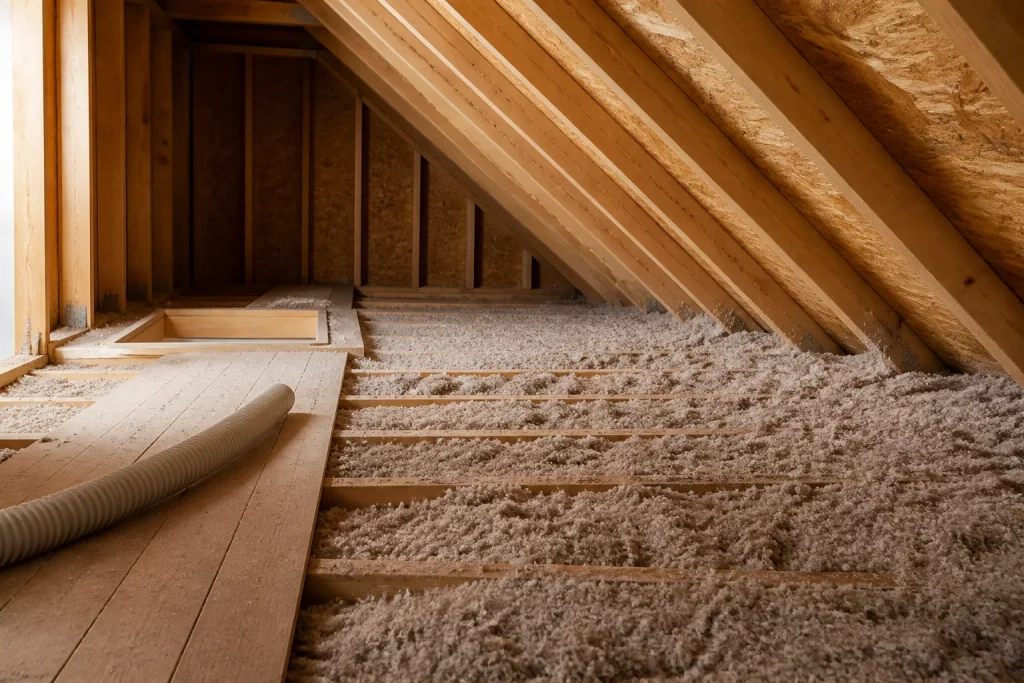
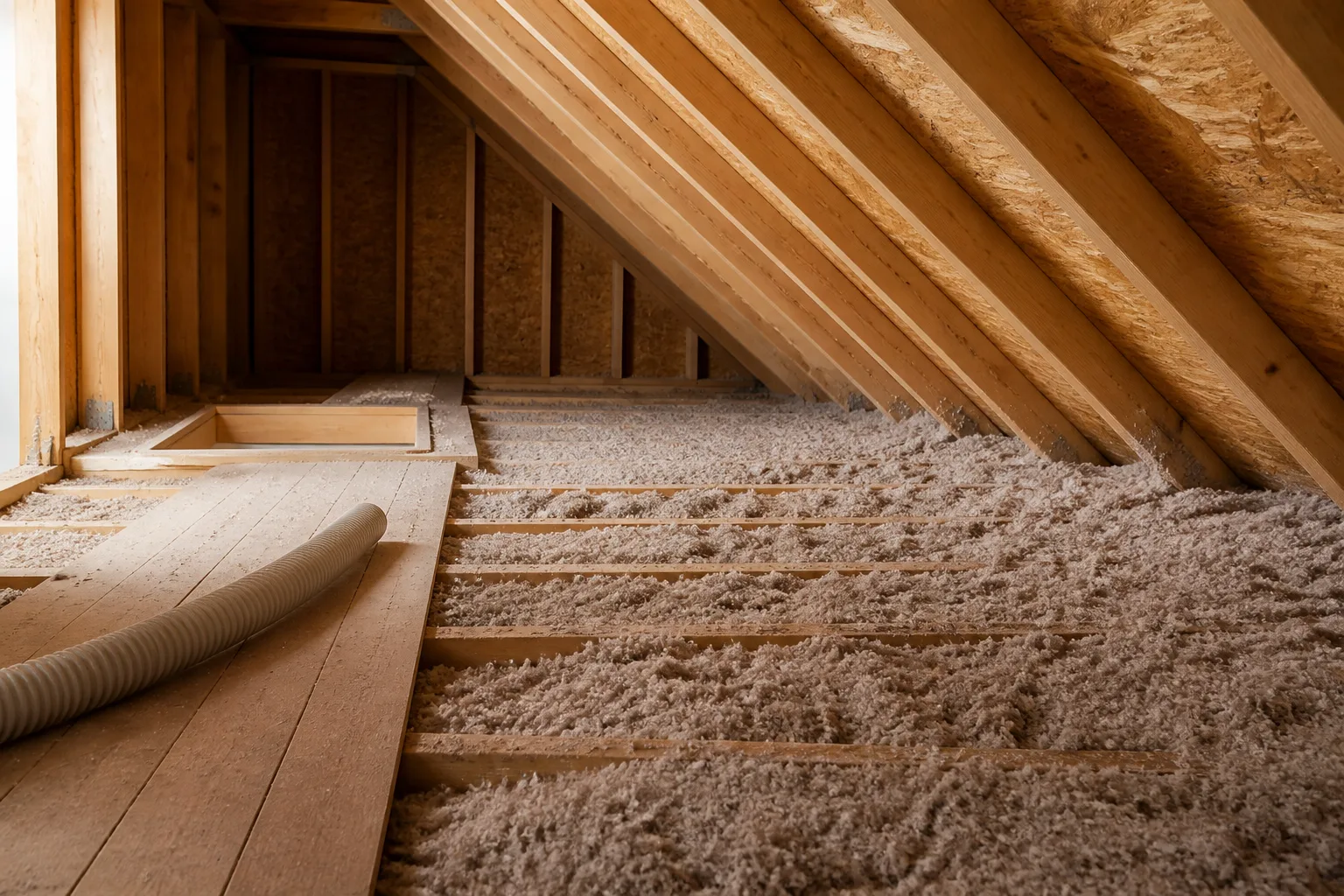
- New installation on a clean attic (no old material to remove): $1,800 – $3,400 for most Enterprise homes in the 1,200 – 2,000 sq ft range. Low end covers blown-in fiberglass at R-38; the high end reflects spray foam in tricky zones or a jump to R-49.
- Installation over existing material (top-up): $1,200 – $2,600. Cheapest path if the existing insulation is still healthy and just thin. We check moisture and compression before recommending this – topping up over wet or settled material wastes your money.
- Full removal plus reinstall (old material hauled out, attic cleaned, new insulation in): $3,200 – $6,500. The high end shows up on homes with contaminated insulation, pest damage, or a heavy layer of old cellulose that’s been cooking in the desert heat for years.
Those figures include the usual labor and standard materials. Air sealing is often billed separately unless the quote says otherwise – which is exactly the gap we’ll get to. For a fuller picture of the material and depth options behind these numbers, see our page on Attic Insulation in Enterprise.
Why do Enterprise quotes run higher than the national average?
Three local factors push the number up, and none of them show up on a national cost calculator.
The depth premium. National code minimums often call for R-38. Desert performance wants R-49 or higher in a lot of Enterprise attics – the attic takes a brutal solar load from May through September, and shallow insulation just lets your AC fight a losing battle. More depth means more material and more labor. That’s real money, and it’s money well spent.
Clark County permitting. Not every insulation job needs a permit, but certain projects – especially those tied to a remodel, a change in insulation type, or work that touches structural elements – fall under Clark County requirements. Pulling a permit takes time and adds cost. A contractor who skips it can quote you lower and hand you the problem later.
Summer scheduling demand. We’re genuinely busier in peak heat, and so is everyone else. A crew working a 140-degree attic in July commands a premium over the same job in February. Booking in spring or fall can save you real dollars in Enterprise, and the insulation will be working for you before the worst of the heat arrives.
The material choice moves the number too. Blown-in fiberglass is the budget workhorse. Cellulose (GreenFiber) performs well and handles air movement. Spray foam – Icynene or Knauf – costs more up front but seals and insulates in one step, which often makes it the smarter long-term call for problem zones like bonus rooms over garages. Our Spray Foam Insulation in Enterprise page breaks down where it earns its price.
What line items show up on the final invoice but not the quote?
This is where the $1.50 number turns into $3.20. Three specific charges tend to appear after the work starts, and none of them are scams individually – they’re just invisible until it’s too late to compare.
- Attic hatch upgrade. That flimsy plywood square in your closet leaks heat like an open window. A proper insulated, weatherstripped hatch adds $150 – $400 and almost never appears on a phone quote.
- Baffle installation at the eaves. Baffles keep insulation from blocking airflow at the roof edge, which prevents moisture problems and keeps the attic venting correctly. Running them along the eaves of a typical Enterprise attic adds $200 – $500. Skip them and your new insulation can cause the very problems it was meant to solve.
- Disposal of old insulation. Hauling out old fiberglass or cellulose isn’t free – dump fees and labor for bagging and removal run $400 – $900 depending on volume. Quotes that lead with “installation” often forget to mention it.
A written, itemized estimate should name all three up front. If yours doesn’t, ask. We pulled a quote apart for a homeowner near the Mountain’s Edge side of Enterprise last month where the “low” bid was missing the hatch upgrade and disposal entirely – once we added both back in, the “expensive” quote was actually $300 cheaper.
R-38 vs R-49: does the extra depth pay for itself in Enterprise?
In most cases, yes. The jump from R-38 to R-49 typically adds $300 – $800 to a job, depending on attic size and material. In a Las Vegas-area climate where the attic bakes for months, that extra depth translates to measurably less heat pushing down into your living space.
Here’s the plain version: insulation slows heat, it doesn’t stop it. The more of it you have, the harder your AC has to work to overcome what gets through. In Enterprise, that difference shows up on the power bill in August and September, which are the two months that matter most. Homeowners who top up to R-49 usually see the upgrade pay for itself within a few cooling seasons – though we won’t hand you a made-up payback month, because it depends on your home, your AC, and how you run it.
If your attic is already at R-49 or better with healthy material, more depth won’t help much. We check before recommending. That’s the kind of thing a written estimate forces everyone to be honest about.
When should you call a pro instead of going it alone?
Attic insulation looks like a weekend project until you’re standing in it. Some work is genuinely dangerous, and we’d rather tell you that plainly than sell you a reason to skip the call.
- Your attic gets dangerously hot. Summer attic temperatures in Enterprise can hit 140°F or more. Heat exhaustion and heat stroke are real risks for anyone crawling around up there, even early in the morning.
- You suspect moisture, mold, or pest damage. Insulation that looks fine from above can be soaked or contaminated underneath. Disturbing it without knowing can spread the problem.
- You’re dealing with existing spray foam or vermiculite. Some older insulation materials need special handling and shouldn’t be bagged and tossed by a homeowner without knowing what’s in them.
- You want a warranty that means something. A DIY job has no guarantee behind it. When the insulation underperforms next summer, there’s no free second visit coming.
That’s the honest line between “I can do this” and “call someone.” If you’re anywhere near it, call. We answer the phone 24/7 with a live person, and we’ll tell you straight whether you need us. For the full menu of what we do, our overview of Blown In Insulation in Enterprise is a good place to start.
What does a written price actually save you in Enterprise?
The gap between a quoted price and a final invoice is where homeowners lose money, and it’s a gap a written, itemized estimate closes before the first staple goes in. We don’t start any job in Enterprise without a written price in hand – no exceptions, no “we’ll figure it out on site.”
That one habit eliminates the three surprise charges we covered above, the mid-job upsell, and the awkward conversation at the end. And it pairs with the 365-Day Done Right Promise: if the finished job doesn’t perform the way the written estimate said it would – attic not holding temperature, depth coming up short, a repair that fails – we come back and make it right, in writing, covering labor and materials for a full year. If a covered repair fails, the second visit is free. In cost terms, that’s the difference between a gamble and a warranty.
Every technician who shows up at your door is background-checked, identity-verified, in a clean marked uniform with a photo ID badge – and you get their name and photo before they arrive. If anyone else shows up, the visit is free. That’s The Threshold Standard, and it’s the reason a homeowner who’s home alone with young kids can open the door without a second thought.
The Bottom Line
Attic insulation in Enterprise in 2026 runs roughly $1,800 to $4,900 for most jobs, with full removal-and-reinstall pushing toward $6,500. The national numbers you’ll find online leave out the three things that actually move your cost: the desert depth premium, Clark County permitting, and the line items – hatch, baffles, disposal – that show up late. A written, itemized estimate closes that gap before work begins, and a written guarantee closes the next one.
If you’re in Enterprise and want a straight number instead of a surprise, Aspen Attic Insulation Enterprise offers free estimates – call (844) 761-9996. A live person answers, day or night, and you’ll have a written price before anyone touches your attic.
Frequently Asked Questions
How much does attic insulation cost in Enterprise in 2026?
Most Enterprise attic insulation jobs cost between $1,800 and $4,900, with full removal and reinstall running $3,200 to $6,500. The final number depends on your existing material, attic condition, and whether you’re going to R-38 or R-49. Call (844) 761-9996 for an exact quote – estimates are free.
Is it cheaper to top up existing insulation or remove and reinstall?
Topping up over existing material is almost always cheaper – usually $1,200 to $2,600 versus $3,200 to $6,500 for a full removal and reinstall. But topping up only makes sense if the old insulation is dry, uncontaminated, and still doing its job. If it’s soaked, compressed, or pest-damaged, removal is the only honest answer. Call us and we’ll help you tell which one you’re looking at.
Do I need a Clark County permit to insulate my attic in Enterprise?
It depends on the project. Straight insulation top-ups often don’t require one, but work tied to a remodel, a change in insulation type, or anything touching structural elements usually does. A contractor who can’t tell you whether your job needs a permit in Clark County is one to walk away from. Ask before you sign.
Can you come out today?
In many cases, yes – and we answer the phone 24/7 with a live person, not a voicemail loop. Call (844) 761-9996 and we’ll get you a written price before any work starts. Summer in Enterprise is our busiest stretch, so the sooner you call, the better your scheduling options.
For a full look at everything we do across the valley, start at the Aspen Attic Insulation Enterprise home page, or call us directly – we’re glad to talk it through.
Written by the team at Aspen Attic Insulation Enterprise.
Need Insulation Help?
Call Aspen Attic Insulation Enterprise - licensed & insured, here with fast after-hours help in Enterprise.
(844) 761-9996