
Last updated November 18, 2026
Attic Insulation Troubleshooting: Common Problems and How to Fix Them
If your energy bills went up after adding attic insulation, you probably didn’t get ripped off. You likely buried a ventilation defect and made it worse. It happens more often than any installer will admit. We’ve walked into attics in Enterprise where a homeowner paid good money for a fresh layer of blown-in fiberglass, only to find the soffit vents packed solid and the ridge vent sealed with paint overspray. The insulation was doing its job. The house was suffocating behind it.
This guide is about diagnosing the root cause before you pay to add more material on top of a problem. You’ll learn the three-symptom test, how to spot settled or compressed insulation with a flashlight and a tape measure, why moisture stains in Enterprise almost always trace back to duct leakage, and when adding insulation is the last step rather than the first.
Quick Answer
Most attic insulation problems are caused by something the insulation is hiding – a blocked soffit vent, a disconnected HVAC duct, or settled material creating a cold bridge – not by the insulation itself. Diagnose the root cause first: check airflow from soffit to ridge, look for moisture staining near ducts, and measure insulation depth against the R-value you need. Adding more insulation before fixing those defects traps heat, humidity, and money in the same attic.
Table of Contents
- The Three-Symptom Test: What Hot Rooms, Musty Smells, and Rising Bills Are Telling You
- How to Spot Settled or Compressed Insulation With a Flashlight and Tape Measure
- Why Moisture Stains in a Desert Climate Mean Duct Leakage
- The Soffit-to-Ridge Airflow Check You Can Do Without Entering the Attic
- Six Root Causes That Look Like Insulation Failure
- When Adding Insulation Fixes the Problem vs. When It’s the Last Step
- Common Mistakes to Avoid
- When to Call a Professional
The Three-Symptom Test: What Hot Rooms, Musty Smells, and Rising Bills Are Telling You
Homeowners tend to lump every attic complaint into one bucket labeled “bad insulation.” In our experience across Enterprise, those complaints split into three distinct symptoms, and each one points at a different underlying defect. Get the symptom right and the diagnosis gets a lot faster.
- Hot rooms in summer, especially upstairs bedrooms on the west side: usually a radiant heat problem combined with thin or settled insulation over the ceiling plane. The attic is baking and the ceiling is transferring heat straight down. This is the classic case where more depth actually helps – but only after you confirm the vents aren’t blocked.
- Musty or “old basement” smell that shows up when the AC runs: almost always a moisture problem, and in Enterprise that usually means an HVAC duct pulling humid air from the attic into the living space. Insulation can’t fix a smell. You have to find the duct.
- Utility bills climbing month over month with no rate change: the sneaky one. A gradual bill increase with no obvious comfort issue often means insulation has settled and lost R-value, or a duct has separated slightly and is dumping conditioned air into the attic. Both drift slowly enough that you don’t notice until the bill arrives.
One symptom, one direction. If you have all three at once, you almost certainly have a ventilation defect hiding under the insulation, and that’s the scenario we see most often in older Enterprise homes where a previous owner topped up the attic without checking the soffits first.
How to Spot Settled or Compressed Insulation With a Flashlight and Tape Measure
You don’t need special tools to check whether your blown-in insulation has lost its depth. A bright flashlight and a tape measure will do it, and you can do it from the attic access hatch in most homes without crawling deep into the space.
- Wait for a cool morning. Insulation is easiest to read when the attic isn’t 140 degrees. In Enterprise, that’s usually before 9 a.m. in summer.
- Shine the light across the surface, not down at it. Raking light shows the profile of the material – whether it’s fluffy and even or flattened into a mat.
- Measure depth at three points – near the hatch, at the center of the attic, and along the outer wall. Blown-in fiberglass settles differently in each spot, and the edges are where compression usually happens first.
- Compare your number to the target. In our climate, we generally want to see 12 to 15 inches of blown-in fiberglass or cellulose to hit the R-value that keeps an Enterprise attic performing. If you’re measuring 6 inches where you measured 10 a few years ago, you’ve lost depth to settling or compression.
- Look for footprints, boxes, and duct runs. Anything resting on the insulation compresses it and creates a cold bridge – a path where heat moves straight through the flattened material. That’s a repair, not a top-up.
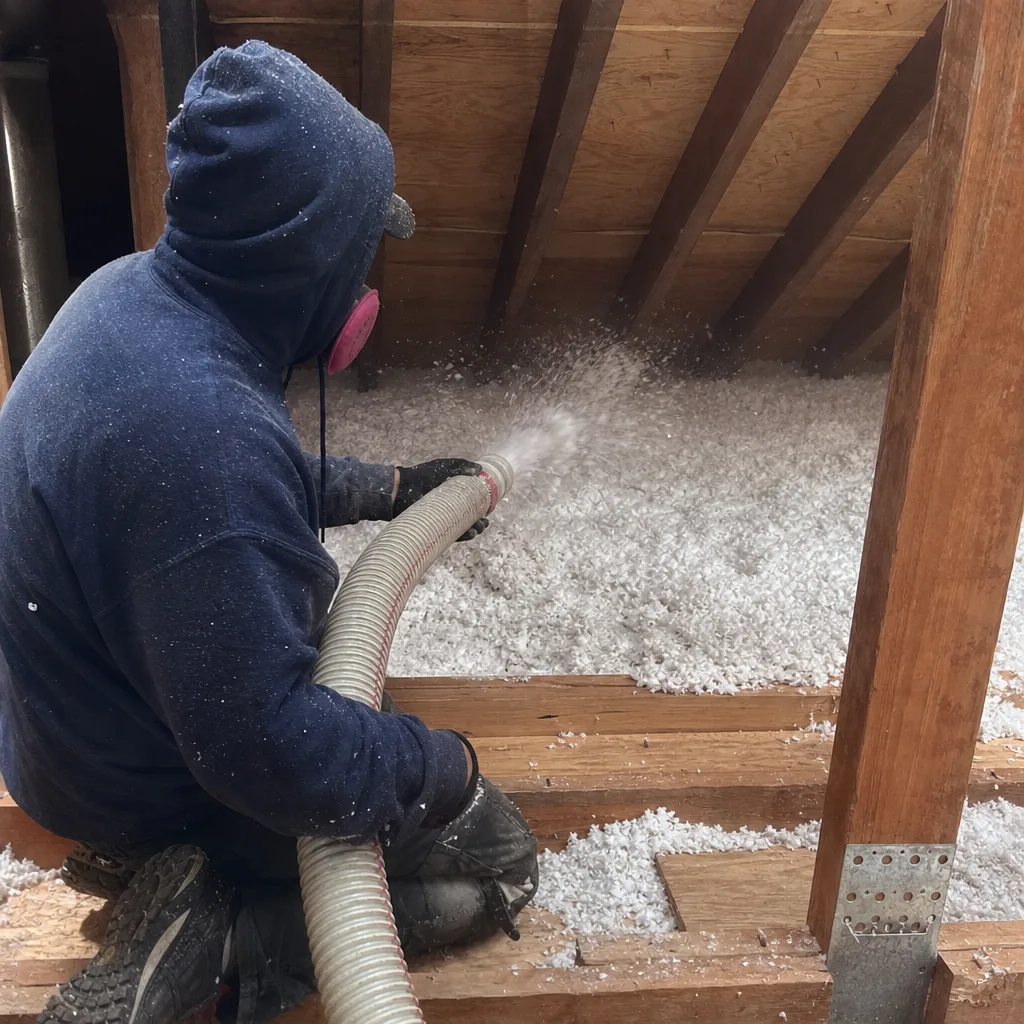
Compressed insulation under plywood walkways or HVAC platforms is a common finding in Enterprise homes built in the 1990s and 2000s. It’s also the cheapest problem to fix once you know it’s there. Our Blown In Insulation in Enterprise service exists partly for this reason: loose fibers can be re-fluffed and topped up to fill the gaps a batt can’t reach.
Why Moisture Stains in a Desert Climate Mean Duct Leakage
Here’s the counterintuitive part. In Enterprise, a water stain on attic insulation is rarely about rain getting in. It’s almost always about conditioned air getting out.
Your air conditioner pushes cold air through ducts that run through the attic. In a dry desert climate, those ducts are often the coldest surface in the attic, and any gap, disconnected joint, or poorly sealed boot lets cold air spill into the attic. That air meets warm, dry attic air – and if there’s any humidity in the system (from a bathroom fan venting into the attic, or a small roof leak you haven’t noticed), condensation forms right at the leak point. The stain you see on the insulation is where the moisture landed, not where it started.
What does that look like in practice? A dark, discolored patch on blown-in insulation directly under a duct run. Sometimes you’ll see it as a ring. Sometimes the insulation is matted down in a specific line. We’ve found duct boots disconnected by nothing more than a rodent or a house settlement shift, dumping hundreds of dollars of cooling into the attic every summer in Enterprise homes.
The fix isn’t insulation. It’s sealing the duct. Once the duct is sound, the moisture stops, and then – and only then – you address the insulation depth. If you see staining and you’re not sure whether it’s a duct or a roof issue, a professional attic inspection is the fastest way to sort it out. The Attic Insulation in Enterprise service includes a full duct and ventilation check before any material goes down.
The Soffit-to-Ridge Airflow Check You Can Do Without Entering the Attic
This is the check every homeowner should do before spending a dollar on insulation, and you can do it from the ground or from a stepladder at the soffit, with no attic access required.
- Stand under a soffit vent on a breezy day. You should feel air moving. If you feel nothing, the soffit is likely blocked by insulation, paint, or a baffle that’s been pushed out of place.
- Hold a tissue near the ridge vent from inside the attic hatch. On a windy day, the tissue should move slightly. No movement means the ridge is sealed or the soffit isn’t feeding it.
- Run the bathroom fan and the dryer, then check again. A house that can’t vent through soffit and ridge will pull air through gaps in the ceiling, which is why your upstairs rooms smell like cooking, pets, or attic dust.
- Walk the perimeter and look for sagging or painted-over soffit screens. A soffit that’s been painted shut is a very common DIY problem in Enterprise homes, and it costs about $200 to $500 to correct, versus thousands to re-insulate an attic that didn’t need it.
Airflow runs bottom to top. Soffit vents let air in at the eaves; ridge vents let it out at the peak. If either end is blocked, the whole system stalls, and every insulation problem in the attic gets worse. This is why “just add more insulation” so often backfires. You’re sealing a box that had no way to breathe.
Six Root Causes That Look Like Insulation Failure
In our experience troubleshooting Enterprise attics, these six defects account for the large majority of “the insulation isn’t working” calls. None of them are the insulation’s fault. All of them get worse if you keep adding material.
- Blocked soffit vents: insulation blown right up against the roof deck seals off the intake. Fix with baffles or by re-routing material.
- Disconnected or torn HVAC ducts: conditioned air escapes into the attic. Fix by sealing or reconnecting the duct run.
- Settled blown-in insulation: loose fibers lose depth over time, particularly at the outer edges. Fix by re-fluffing and topping up to the target depth.
- Compressed insulation under walkways and platforms: creates a cold bridge straight through the ceiling. Fix by re-insulating around obstructions with rigid board or by relocating the platform.
- Missing or damaged radiant barrier or vapor retarder: in Enterprise’s heat, a damaged barrier lets radiant heat straight down. Fix by repairing or replacing the barrier.
- Air leaks at the ceiling plane: recessed lights, attic hatches, and top plates that aren’t air-sealed. Fix with spray foam at the penetration points.
Notice that only two of those six are insulation problems. The other four are air, moisture, and duct problems that the insulation is hiding. This is exactly why troubleshooting starts with inspection, not purchase. If your problem is one of the air-sealing items, our Spray Foam Insulation in Enterprise service can close the gaps in one visit.
When Adding Insulation Fixes the Problem vs. When It’s the Last Step
This is the single most important judgment call in attic troubleshooting. Adding insulation fixes the problem when the only defect is depth. It’s the wrong move – and often makes things worse – when a ventilation, moisture, or duct problem is present.
Adding insulation is the right first move when:
- You’ve confirmed soffit and ridge vents are open and moving air.
- You’ve measured depth with a tape and it’s below target.
- There’s no moisture staining and no musty smell.
- Ducts are sealed and connected.
Adding insulation is the last step when:
- Any soffit or ridge vent is blocked.
- You find any moisture staining, wet insulation, or musty smell.
- A duct is disconnected, torn, or unsealed.
- There are ceiling-plane air leaks around lights or the attic hatch.
- Insulation is compressed under platforms or walkways.
In that second list, you fix the underlying defect first and let the insulation work correctly once the attic can breathe. In Enterprise, where summer attic temperatures routinely push past 140 degrees, a sealed, unventilated attic doesn’t just cost you money – it can degrade shingles and trap moisture. We’ve seen it enough times to write it as a rule: diagnose first, then insulate. If you’re on the fence, our Aspen Attic Insulation Enterprise home page explains how the free estimate process works, and the written price you receive before any work starts shows you exactly what you’re paying for.
Common Mistakes to Avoid
- Adding insulation without checking the soffits first. This is the number one mistake we see in Enterprise. New material goes down, bills go up, and the homeowner thinks insulation doesn’t work.
- Venting a bathroom fan into the attic instead of through the roof. It’s cheaper and faster, and it dumps warm, humid air straight into the insulation. In a desert climate, that moisture has nowhere to go.
- Assuming a water stain means a roof leak. In Enterprise, it almost always means duct leakage. Get the duct inspected first, roof second.
- Compressing insulation under plywood walkways to “make room” for storage. Every square foot of walkway is a cold bridge. If you need attic storage, build up the framing so the insulation depth is preserved underneath.
- Topping up over old, matted insulation without re-fluffing. New material on top of compressed material doesn’t restore R-value. The old layer has to be addressed, not buried.
- Skipping air-sealing the attic hatch and recessed lights. A one-inch gap around the hatch can dump as much heat into the attic as a fist-sized hole in the ceiling.
- Choosing insulation by price alone. The right material for one attic may be the wrong one for another. We work with Owens Corning, Johns Manville, GreenFiber, and six other premium brands so the product matches the problem, not the other way around.
When to Call a Professional
Some attic work is genuinely a homeowner job. Measuring depth, checking soffit airflow, and looking for staining are all safe and easy. Other work is not, and it’s the kind of thing that goes wrong quietly. Disconnected ducts, air-sealing around recessed lights (which can be a fire hazard if done with the wrong material), and anything involving the electrical wiring that runs through the attic are all professional territory. So is moisture diagnosis – a wet attic that keeps getting wetter is a problem you want fixed the first time. If you’ve done the airflow check and the depth check and something still feels off, that’s the call. Aspen Attic Insulation Enterprise offers free estimates in Enterprise – call (844) 761-9996 and we’ll send a background-checked, uniformed technician whose name and photo are sent to you before the visit. You’ll get a written price before any work starts, and every job carries the 365-Day Done Right Promise. Our technicians are experienced, with up to 24 years on the tools.
Frequently Asked Questions
Your energy bills likely went up because the new insulation sealed off a ventilation or duct defect that was already there – usually a blocked soffit vent or a disconnected HVAC duct – so the attic is now trapping heat and moisture instead of venting it. Adding insulation on top of a problem makes the problem worse, not better. Call (844) 761-9996 for a free inspection and we’ll diagnose the root cause before recommending any material – estimates are free.
Measure the depth with a tape measure at three points – near the hatch, at the center, and along the outer wall – and look for flattened, matted material under walkways, platforms, or duct runs. In Enterprise, we generally want to see 12 to 15 inches of blown-in fiberglass or cellulose to hit the right R-value; if you’re measuring half that where it used to be deeper, settle has occurred. A tape measure and a flashlight will tell you most of what you need to know.
Moisture staining on attic insulation in Enterprise usually means HVAC duct leakage, not a roof leak. The conditioned air spilling out of a duct meets warm attic air and condenses at the leak point, leaving a stain directly under the duct run. Get the duct inspected first. Call (844) 761-9996 for a free estimate if you see staining and want a professional read on whether it’s duct, roof, or exhaust fan.
Repairing attic ventilation is almost always cheaper than replacing insulation, and it’s often the only repair you need. Clearing blocked soffit vents, replacing baffles, or sealing a duct typically runs a fraction of the cost of a full insulation replacement, and it makes the existing material work the way it was supposed to. Replacing insulation is the right call only after the ventilation and duct defects are fixed. Call (844) 761-9996 for a written price before any work starts.
Yes. You can check soffit airflow from a stepladder at the eaves – you should feel air moving under a soffit vent on a breezy day – and you can check ridge vent function from inside the attic hatch using a tissue. If neither end moves air, the attic isn’t breathing and insulation won’t perform correctly. For a full soffit-to-ridge check, our technicians do it as part of every free estimate.
The 365-Day Done Right Promise is our written guarantee that covers every repair for a full year, including labor and materials. If the repair fails, we come back for a free second visit and make it right. It’s in writing on every job, alongside the written price you receive before any work starts. Call (844) 761-9996 to schedule your free estimate.
The Bottom Line
Attic insulation troubleshooting is really about diagnosis. Hot rooms, musty smells, and rising bills each point to a different underlying defect, and none of them are fixed by dumping more material on top. Check the soffits, measure the depth, look for moisture under ducts, and confirm the attic can breathe before you spend a dollar on insulation. The fix is usually a $200 to $500 ventilation or duct repair, not a full replacement. When you’re ready for a professional opinion, Aspen Attic Insulation Enterprise offers free written estimates in Enterprise, with background-checked technicians whose name and photo are sent before the visit. Call (844) 761-9996 to get started.
Written by the team at Aspen Attic Insulation Enterprise.