
5 Mistakes to Avoid With Blown In Insulation
Most blown-in insulation failures we see in Enterprise trace back to the 48 hours before and after the job, not the installation itself. Homeowners skip prep work and skip documentation, and those two omissions void warranties and cut performance from day one. If you’d rather not manage the details yourself, call (844) 761-9996 and we’ll walk you through what a clean job looks like.
Mistake #1: Not Clearing a 4-Foot Path to the Attic Hatch
The first mistake happens before the truck arrives. If your attic hatch is blocked by stored boxes, holiday decorations, or that treadmill nobody uses, the crew has to work around the clutter. And when a crew is working around obstacles, the corners and perimeter get skipped. That’s exactly where Enterprise homes lose the most heat.
Enterprise sits in the Mojave high desert, where summer attic temperatures routinely push past 140°F and winter nights drop into the 30s. The temperature swing is brutal on insulation, and the perimeter of your attic floor is where the gap between conditioned and unconditioned space is widest. When loose fill is blown in unevenly because the technician couldn’t reach that far corner, you get what installers call a perimeter depth deficit. The center of the attic looks fine. The edges don’t.
Before the crew shows up:
- Clear a 4-foot-wide path from the attic access door to the main attic floor area.
- Move anything stored directly around the hatch and along the rafters near the entry.
- If your attic access is in a closet or garage, clear that space too – the staging area matters.
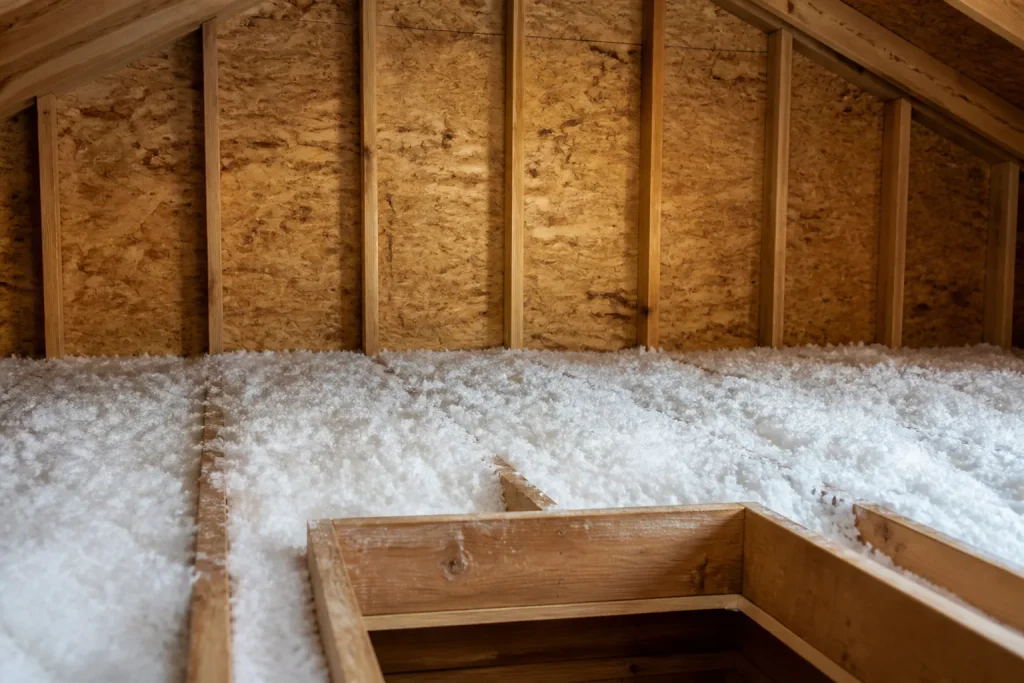
The day after installation, measure the depth yourself. Use a ruler or a marked stick and check at least four spots: center, and three points near the perimeter. If the perimeter reads an inch or more shallower than the center, ask questions. A proper job, whether it’s blown in insulation in Enterprise done by our crew or anyone else’s, should read consistent depth across the whole attic floor.
Mistake #2: Running the HVAC During Installation
Nobody tells you to turn off the HVAC. So it stays on, and the return air keeps pulling. Here’s why that matters: your duct system is pressurized while the blower runs, and any gaps or leaks in the return ductwork will actively suck loose insulation fibers toward them. The material gets displaced mid-install. The crew keeps blowing, the coverage looks adequate from the hatch, and you end up with thin spots around the duct runs that nobody catches until the next energy bill.
We’ve seen this in homes across the Enterprise area, especially older builds where the return ducts run through the attic chase. The fix is simple: turn off your heating and cooling system at the thermostat before the crew starts. Leave it off until they’re done and have packed up. That’s usually a few hours on a standard attic job.
Ask the crew upfront whether they’ll remind you to shut the system down. A company that plans for this will tell you before they arrive. If they don’t mention it, mention it yourself.
Mistake #3: Accepting a Quote in Bags Instead of Installed R-Value
Bag count means nothing without a density specification. We’ve seen quotes that read “20 bags of blown-in” with no R-value attached, and that’s not a meaningful number. Different materials expand at different rates. Twenty bags of one product at one density might hit R-38. Twenty bags of another at a looser density might land at R-30. You can’t compare quotes by bag count.
What you want on the written quote:
- Target R-value – the insulation’s resistance to heat flow. For Enterprise’s climate zone, an attic typically wants R-38 to R-49 for meaningful performance.
- Installed depth in inches – the depth the crew will achieve to hit that R-value with the specific product they’re using.
- Product brand and type – GreenFiber cellulose and Owens Corning fiberglass behave differently and get installed at different densities.
Every homeowner we work with gets a written price before any work starts, and that price spells out the target R-value and installed depth, not a bag count. That’s part of the 365-Day Done Right Promise – if the delivered R-value doesn’t match what’s on the paperwork, we make it right. Ask any contractor you’re considering for the same thing in writing. If they can’t produce it, that’s your answer.
Mistake #4: Not Photographing Depth Gauges Before the Crew Leaves
This one costs homeowners real money down the road. Insulation settles over time. That’s normal. But if you file a warranty claim two years from now because your attic isn’t performing, the first question anyone asks is: how deep was it on day one? Without photographic evidence, you have no proof. The contractor says it was installed to spec. You say it wasn’t. It becomes a standoff.
Before the crew pulls out of your driveway, walk the attic with them and photograph the depth gauges. Most installers staple a marked depth gauge every few feet along the attic floor so they can verify coverage. Take photos of every one you can see. Get a shot of the center, the perimeter, and the corners near the duct runs. Timestamp them on your phone.
We started doing this proactively on every job because we got tired of warranty conversations that went in circles. In our experience, one ten-minute photo walk at the end of the job is the difference between a warranty dispute and a five-minute resolution. If a company won’t let you photograph the gauges before they leave, that’s a red flag worth paying attention to. Ours are happy to walk the attic with you.
Mistake #5: Skipping Air Sealing Before the Blown-In Goes Down
Covering attic bypasses with loose fill is like putting a blanket over a window you left open. The blanket keeps you a little warmer, but the cold air is still pouring in through the gap. Attic bypasses are the gaps, cracks, and penetrations where conditioned air from your living space leaks into the attic – around recessed lights, plumbing chases, top plates, electrical boxes, and the hatch itself.
If those bypasses aren’t sealed before the insulation goes down, the blown-in material can’t do its job. Worse, air moving through the loose fill can actually carry fibers away from where they were installed, leaving thin spots over time. In Enterprise, where attic temperatures swing from 140°F in July to near freezing in January, that airflow is constant.
Air sealing needs to happen first: caulk and foam around penetrations, weatherstripping on the attic hatch, sealing gaps at top plates. Then the insulation goes down over a sealed deck. If a contractor quotes you blown-in without mentioning air sealing, ask whether it’s included. It’s not optional if you want the installation to actually perform.
When to Call a Pro
A few of these mistakes are fixable by a careful homeowner: clearing the hatch path, turning off the HVAC, and photographing the depth gauges after the job. But air sealing and R-value verification need the right tools and the right training, and crawling through a 140°F attic in July isn’t a job we’d recommend to most people. If you’re not sure whether your attic needs sealing, or if you want an honest read on whether your existing insulation is doing its job, that’s a conversation worth having before the next heat wave.
Our technicians have up to 24 years of experience and are background-checked, identity-verified, and arrive in a clean marked uniform with a photo ID badge at the door. You’ll get the tech’s name and photo before the visit, plus a written price before any work starts.
Related services in Enterprise: Attic Insulation in Enterprise · Spray Foam Insulation in Enterprise · Blown In Insulation in Enterprise
The Bottom Line
Blown-in insulation mistakes fall into two camps: the ones you make before the crew arrives, and the ones you make after they leave. Clear the path, shut off the HVAC, demand a quote in R-value not bags, photograph the depth gauges, and make sure air sealing comes first. Those five things are the difference between insulation that performs for decades and insulation that underperforms from day one.
If you’re in Enterprise and want a second opinion on a quote, or want to know whether your attic is set up for blown-in to actually work, we offer free estimates. Call (844) 761-9996 – a live person answers 24/7, and you’ll get a written price before anything else.
You can learn more about how we work at Aspen Attic Insulation Enterprise home.
Frequently Asked Questions
Wait until the crew has finished and packed up before turning your heating or cooling system back on. Running it during installation displaces the loose fill while the blower is on, which can leave thin spots around duct runs. A few hours of downtime is the safe play.
Measure with a ruler or marked stick at four or more spots: the center of the attic and three points near the perimeter. The depth should read consistent across the whole attic floor. If the perimeter reads shallower than the center, ask the contractor why.
Yes. Air sealing should always come first. Blown-in material laid over unsealed bypasses can’t perform the way it’s rated to, because conditioned air keeps leaking into the attic through the gaps. Seal the penetrations, then insulate.
It depends on the installer. Every job we complete is covered by the 365-Day Done Right Promise, which covers labor and materials in writing for a full year, with a free second visit if something fails. If you’re comparing contractors, ask each one what their warranty covers and for how long – in writing.
Give us a call at (844) 761-9996 for a free estimate. We’ll bring the depth gauges and the written price, and you’ll know exactly who’s showing up before anyone knocks.
Written by the team at Aspen Attic Insulation Enterprise.
Need Insulation Help?
Call Aspen Attic Insulation Enterprise - licensed & insured, here with fast after-hours help in Enterprise.
(844) 761-9996