
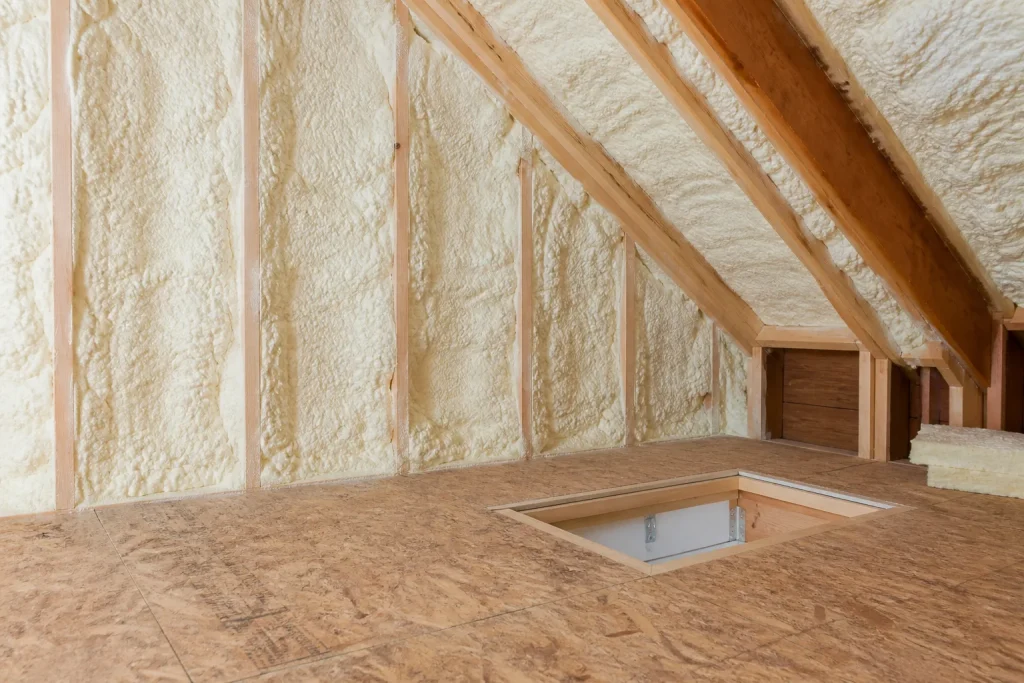
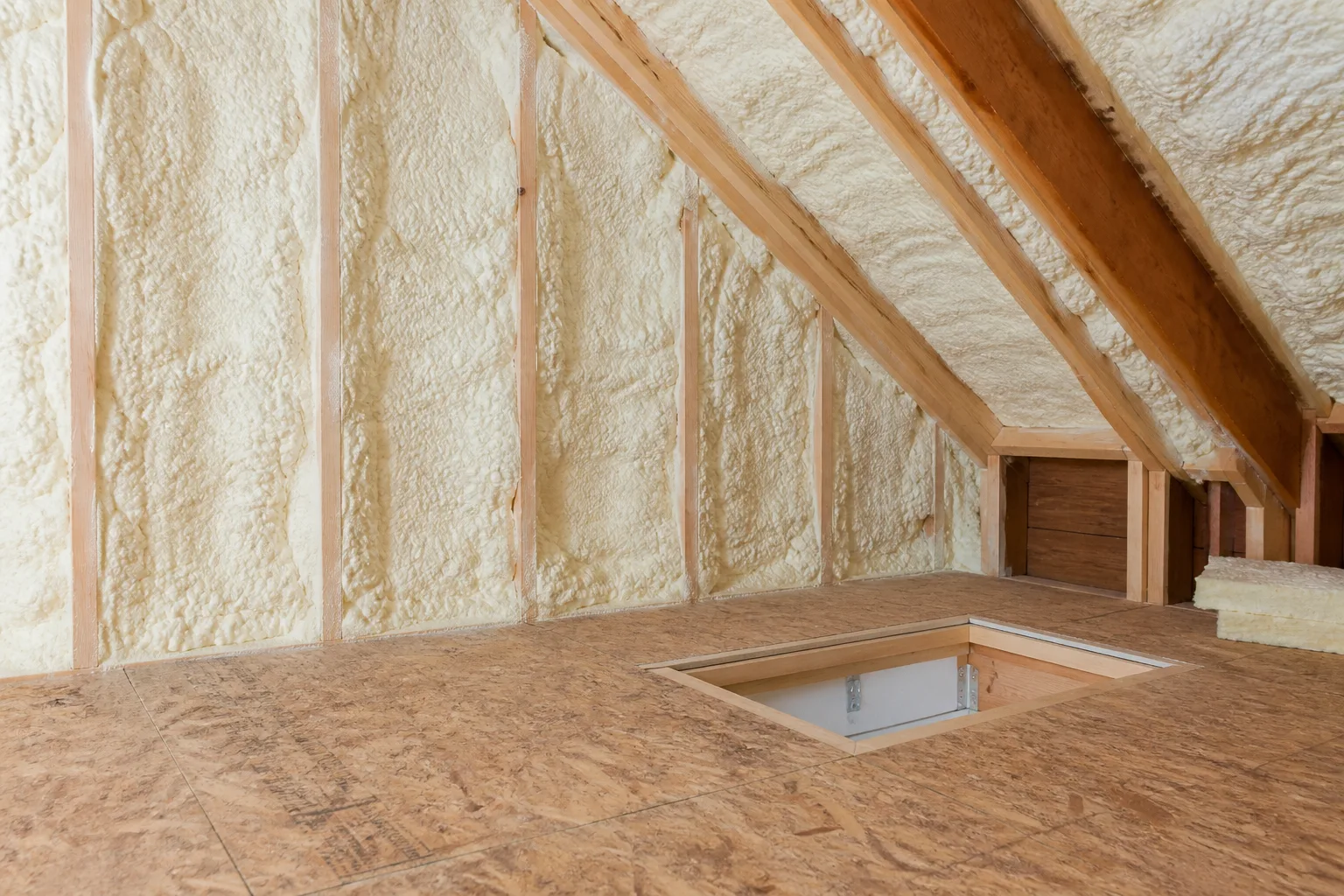
Spray Foam Insulation: Repair or Replace? How Enterprise Homeowners Decide
Here is the short version: spray foam gets repaired when the failure is mechanical and isolated (a small area lost bond, a plumbing cut, a rodent tunnel), and it gets replaced when the failure is structural and widespread (delamination across the roof deck, saturation from a long-running roof leak, or foam that has shrunk away from the framing in multiple bays). The tricky part is that both failures look identical from inside the attic: smooth, hard, and completely convincing. New foam sprayed over the old can bond beautifully or fail to bond at all, and no flashlight will tell you which happened. If you would rather not sort that out alone, call (844) 761-9996 and we will talk it through.
There is one mistake we see in Enterprise again and again, and it costs homeowners a lot of money. Someone gets a quote to “top off” failing spray foam with a fresh coat in a new color. It looks better. It tests better for about a season. Then summer arrives, the roof deck hits 160°F, and the new foam peels away from the old because the two never actually cross-linked. Foam adhesion is chemistry, not carpentry. That is the whole reason this decision is harder than a fiberglass repair, and why the framework below differs from anything you would use on batt or blown-in insulation.
Key takeaways
- Two failure modes dominate Enterprise attics: heat-driven shrinkage and moisture at the roof deck. Shrinkage is often repairable; saturation rarely is.
- Repair only works if the new foam is chemically compatible with the old foam. A mismatched product is a cosmetic fix, not a thermal one.
- Full spray foam removal costs far more than tearing out fiberglass. That shifts the repair-or-replace threshold higher than most homeowners expect.
- Ask for a core sample at three points and a measured R-value before anyone recommends anything.
- A written guarantee on a spray foam repair must name adhesion and R-value retention. If it does not, it is not covering the failure you actually have.
What are the two ways spray foam fails in an Enterprise attic?
In Enterprise, spray foam fails in one of two ways, and they call for opposite decisions. The first is thermal shrinkage from extreme heat cycling. Our summers swing the roof deck through brutal daily temperature changes, and closed-cell foam expands and contracts with the framing. Over years, that cycling can pull foam away from the deck or the studs, creating gaps that leak conditioned air. Shrunk foam that has pulled back in a few bays is a candidate for repair. The foam itself is usually still sound; it just lost its seal.
The second is moisture intrusion at the roof deck, and it is the one that usually ends in replacement. Spray foam is a vapor barrier when it is intact. When a roof leak, a failing flashing detail, or an improperly vented bath fan pushes moisture behind the foam, that moisture has nowhere to go. The foam traps it against the wood. We have opened attics where the foam looked flawless and the OSB underneath was soft enough to push a screwdriver through. Saturated or delaminated foam cannot be dried out and re-bonded; it has to come out so the deck can be inspected and dried.
- Shrinkage gaps, minor: repairable in most cases.
- Foam pulled back across multiple bays: assess with core samples before deciding.
- Soft, spongy, or bubbling foam: treat as moisture damage.
- Discoloration or musty smell at the deck: replacement territory; the wood has to be seen.
Why does spray foam repair depend on chemistry, not just skill?
Spray foam is a two-component system. The A-side (isocyanate) and B-side (polyol resin) meet at the gun and react on contact. Foam bonds to what it is sprayed onto by cross-linking and mechanical grip, and both depend on the substrate. Fresh foam sprayed onto clean, sound, fully cured foam of a compatible formula can bond well. Fresh foam sprayed onto aged, dusty, sun-degraded, or contaminated foam often will not, no matter how good the installer is.
This is where a lot of Enterprise repair jobs go sideways. A contractor shows up without matching the existing product, fills the gaps with whatever closed-cell foam is on hand, and it looks seamless. Six months later the patch has separated. If the existing foam was, say, an Icynene or Demilec product, the honest approach is to identify the original type and pick a compatible foam. Where compatibility cannot be confirmed, the right move is to remove the affected section first, prep the substrate, and re-spray clean rather than gluing new foam onto an unknown surface. That is more work. It is also the only version that holds.
To be fair to the trade, compatibility is genuinely hard to verify, and the industry has not standardized a “match old foam” procedure for homeowners to lean on. So ask the question directly: what product is on my deck now, and what product are you spraying over it? A contractor who can answer that is telling you they think in chemistry.
How does spray foam repair cost compare to a full tear-out in Enterprise?
Spray foam changes the math because removal is the expensive part. Fiberglass and blown-in insulation come out with a vacuum. Spray foam has to be cut, pried, ground, or shaved off the framing and the deck. For a homeowner deciding repair versus replace, the numbers matter more here than for any other insulation type. Here are the ranges we typically see quoted in the Enterprise market:
| Scope of work | Typical range |
|---|---|
| Targeted spray foam repair (small gaps, a few bays, already prepped) | $400 – $1,200 |
| Spot removal of a saturated section plus re-spray | $1,200 – $3,000 |
| Full attic spray foam removal (typical 1,500 – 2,000 sq ft roof area) | $3,000 – $8,000 |
| Full removal plus fresh closed-cell install | $6,000 – $14,000 |
| Diagnostic – core samples and R-value measurement | $150 – $350 (often credited toward the job) |
Compare that with fiberglass, where a full tear-out on a similar attic runs closer to $500 to $1,200 because the material is easy to pull. Spray foam costs more because the removal takes real labor hours. That is the threshold shift: where a fiberglass repair might be worth doing at three times the cost of a patch, spray foam rarely is. If the repair quote lands above roughly 40% of the replacement cost, replacement is usually the better long-term call. Prices move with roof pitch, accessibility, and how many bays are involved, so treat the table as a map, not a bill. For the full picture of what installs and repairs run in this market, see our page on Spray Foam Insulation in Enterprise.
How do you get an honest assessment of existing spray foam?
You ask for data, and you ask for it before anyone recommends a repair or a replacement. The good news is that foam is testable. Here is the step that separates a real assessment from a sales visit:
- Core-sample the existing foam at three points. A core is a small plug the contractor pulls out of the foam to see thickness, cell structure, and whether the foam is adhered at the bottom. One sample is a guess; three points across the attic gives you a picture.
- Measure current R-value. Foam loses performance as it ages and shrinks. A measured R-value tells you how much heat resistance is left and whether repair is even worth it.
- Check adhesion at the deck and the studs. The sample should reveal whether the foam is still bonded or has pulled away.
- Look for moisture. A moisture meter at the deck and a visual check of the OSB catches the failure that shrinkage hides.
- Write the findings down. Ask for the numbers in writing, not just a verbal “yeah, it’s fine.”
No honest contractor will recommend a repair without sampling first. If you get a quote to top off the foam and nobody has pulled a core, you have not had an assessment. You have had a sales call. In our experience, most Enterprise spray foam repair jobs that went wrong started with exactly that – a quote with no sampling behind it.
What should a written guarantee on spray foam repair actually say?
A written guarantee on a spray foam repair needs to cover two things: adhesion performance and R-value retention. If it only says “we guarantee our work,” it is guaranteeing the wrong failure. The failure that erodes spray foam is a patch that loses bond or the deck that measures low on insulation down the line, so the language has to name those. That is also why a lot of contractors avoid putting those terms in writing. It commits them to chemistry they cannot fully control.
Our answer to that is the 365-Day Done Right Promise, backed in writing on every job, covering labor and materials for a full year, with a free second visit if the repair fails. For spray foam specifically, that includes adhesion and measured R-value retention, because those are the failures a repair exists to prevent. We also give you a written price before any work starts, so nobody comes at you with a “while we were in there” charge at the end. And because a homeowner watching an unfamiliar crew open up a roof deck deserves to know who is showing up, every technician is background-checked, arrives in a clean marked uniform with a photo ID badge, and you get their name and photo before the visit. If anyone else arrives, the visit is free. That is the standard we hold on every Enterprise job.
When should you call a pro for spray foam in Enterprise?
Call a professional the moment the failure involves the roof deck, moisture, or anything structural. Spray foam sits against the roof deck, and getting it wrong means water finding its way into the framing where you cannot see it. This is not a fan of DIY work. The two-component chemistry, the adhesion question, and the moisture risk all push past a weekend project.
You should also call if you are seeing any of these:
- Gaps or pull-back at the foam-to-framing lines
- Soft or spongy foam, or a musty smell in the attic
- Condensation on the underside of the roof in winter
- A roof leak that has been “fixed” but foam still feels damp
- A contractor pushing a top-off without sampling
We pulled a section of foam out of an attic near the Enterprise foothills last season and the OSB behind it crumbled in our hands; the homeowner had a spotless “repaired” top coat that had been sitting over wet wood for two years. A core sample would have caught it in fifteen minutes. That is the whole case for the diagnostic step in one sentence.
Related services in Enterprise: if the foam is sound but the rest of the attic needs help, see Attic Insulation in Enterprise, Blown In Insulation in Enterprise, and start from our Aspen Attic Insulation Enterprise home page.
The Bottom Line
For Enterprise homeowners, the repair-or-replace question on spray foam comes down to chemistry and moisture. A small, isolated failure in sound, compatible foam is repairable. A saturated, delaminated deck across multiple bays is not; it needs removal so the wood can be seen. Insist on core samples at three points and a measured R-value before you authorize anything. Demand a written guarantee that names adhesion and R-value retention. And treat the repair quote against the removal cost math: because spray foam removal is expensive, the threshold for replacing rather than patching is higher than most homeowners expect.
If you’re in Enterprise and need help, Aspen Attic Insulation Enterprise offers free estimates, written prices before any work starts, and the 365-Day Done Right Promise. Call (844) 761-9996 and a live person will pick up.
Frequently Asked Questions
Yes, but only when the existing foam is clean, cured, sound, and chemically compatible with the new product. If the old foam is aged, dusty, degraded, or an unknown formula, the patch can look fine and still fail to bond. In that case the right move is to remove the affected section and re-spray clean. New foam over a mismatched surface is a cosmetic fix, not a thermal one.
Targeted repairs typically run $400 to $1,200 for small gaps across a few bays. Spot removal of a saturated section plus re-spray runs $1,200 to $3,000. A full attic removal is $3,000 to $8,000, and removal plus a fresh install is $6,000 to $14,000. Call (844) 761-9996 for an exact quote; estimates are free.
Repair is cheaper when the failure is isolated and the foam is still bonded. Replacement is cheaper over time when shrinkage or moisture has spread across multiple bays, because repeated patches stack up and each one costs more than the last. The rough guide: if the repair quote lands above about 40% of the full removal and re-spray cost, replacement is usually the better call.
Look for gaps or pull-back where the foam meets the framing, soft or spongy texture, a musty attic smell, condensation under the roof deck in winter, or discoloration in the OSB behind the foam. Visual signs miss a lot, though. The reliable test is a core sample at three points with a measured R-value, which is why we recommend it before any repair is scheduled.
Written by the team at Aspen Attic Insulation Enterprise.
Need Insulation Help?
Call Aspen Attic Insulation Enterprise - licensed & insured, here with fast after-hours help in Enterprise.
(844) 761-9996