
Attic Insulation: Repair or Replace? How Enterprise Homeowners Decide
Most Enterprise homeowners ask the wrong question first. They ask “how old is my insulation?” when they should ask “what is my insulation actually doing?” Age tells you almost nothing. Here’s the short answer: repair, meaning top off and seal, is genuinely viable when the existing material is dry, uncontaminated, and evenly spread. Full replacement is the only honest option when the material is wet, pest-damaged, or asbestos-containing. The rest is arithmetic. If you’d rather not climb into a 140-degree attic to run the numbers yourself, call (844) 761-9996 and we’ll walk you through it.
Here’s the trap. The person handing you the estimate usually has a financial interest in one answer. A contractor who only does full removal will find a reason to replace. A contractor who only does quick top-offs will tell you a patch is all you need. We’re writing this piece because Enterprise homeowners deserve the neutral calculation, not the version that happens to be more profitable that week.
What’s the Difference Between Repairing and Replacing Attic Insulation?
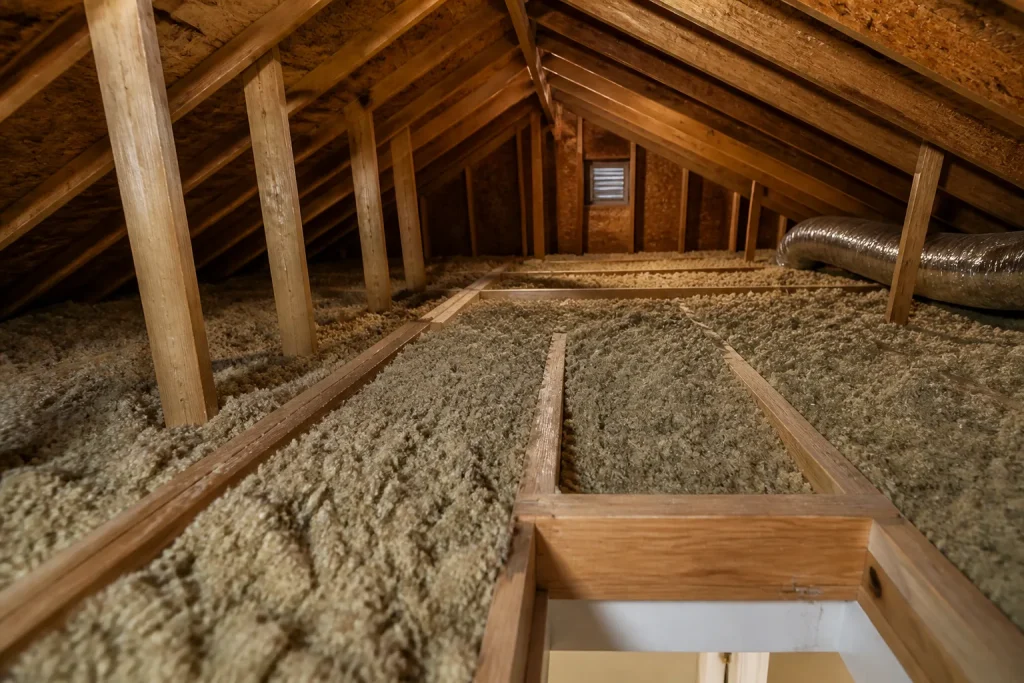
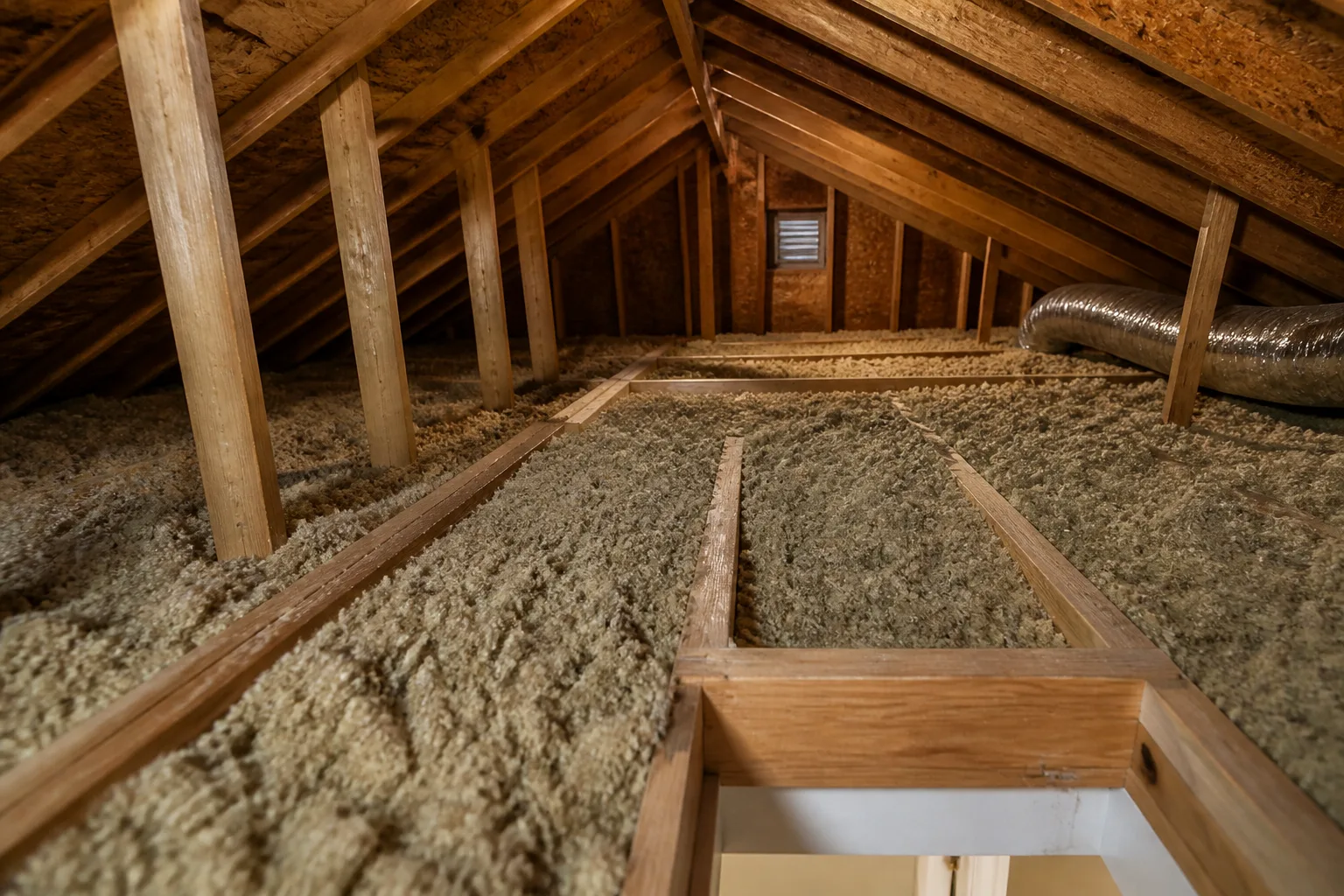
Repairing attic insulation means adding material on top of what’s already there (a “top-off”) and sealing the air leaks feeding the attic from below. Replacing means pulling the old material out entirely, air-sealing the bare ceiling deck, and installing new insulation from scratch. Both end with a full layer of insulation. The difference is what you do with the old layer underneath.
That distinction matters more in Enterprise than in most places. Our summers push attic temperatures well past 150°F, and the swing down to a cold desert night is brutal on fiberglass and cellulose. Material that was fine when it went in can flatten, shift, or trap moisture after a decade of that cycling.
When repair makes sense:
- The old material is dry to the touch and loose, not matted or crusted.
- Depth is consistent across the attic, just too shallow. You’re adding inches, not filling holes.
- There’s no pest evidence, no droppings, no nesting, and no musty smell.
When replacement is the only real answer:
- The insulation is wet, clumped, or has visible water staining on the joists.
- Rodent or insect contamination runs through the layer.
- The material is vermiculite or an unknown older product (more on that below).
We’ve seen all three in Enterprise attics, and they don’t announce themselves. You have to look.
What Should You Actually Check in Your Enterprise Attic?
Three visual tests settle most of the repair-or-replace question, and none of them require tools. Do them in daylight with a good flashlight and a respirator, and stop if you see anything that looks like vermiculite.
- The squeeze test. Grab a handful of the insulation. Fresh fiberglass and cellulose bounce back. Material that stays compressed in your hand has lost its loft and is no longer doing its job, no matter how thick it looks.
- The moisture test. Press your hand against the material near the edges and around any bathroom vent or chimney chase. Damp insulation is a replacement job. Seal the source first or you’ll be redoing it next spring.
- The contamination test. Look for droppings, tunnels, nesting material, and staining along the joists. In Enterprise, we regularly find rodent runs in attics near open desert lots and new construction edges. Insulation that’s been tunneled through is not salvageable.
If all three come back clean, you’re a candidate for repair. If any one fails, replacement is the honest answer. A photo of each check is worth more than any verbal description your contractor gives you.
How Do You Calculate Cost per R-Value in Enterprise?
R-value is the number that measures how well insulation resists heat flow. Enterprise attics typically need R-38 to R-49 to handle our climate, and that target comes from the energy code, not from a sales pitch. Most older attics sit somewhere around R-11 to R-19. The gap between what you have and what you need is what you’re paying for.
Here’s the neutral math. Measure your attic’s square footage (length × width, in feet). Then run two numbers:
- Top-off cost: Multiply your square footage by the per-square-foot cost of blown-in material, roughly $1.50 to $2.75 per square foot in the Enterprise market for a proper top-off with air sealing.
- Full replacement cost: Add removal and disposal (often $2 to $4 per square foot on its own) to the installation cost.
A 1,200-square-foot attic that needs a top-off might land around $1,800 to $3,300. The same attic with full removal and replacement could run $4,200 to $8,400 depending on contamination and access. That’s the real spread. Now compare it to what you’re losing each month in cooling bills.
If a top-off costs $2,200 and saves $60 a month, you break even in about three years. If replacement costs $5,500 for the same savings, that’s closer to seven and a half years. The second number only pays off if the old material was actively hurting you, which is exactly why the physical tests come first.
Why Do Old Vermiculite and Early Cellulose Change the Decision?
Enterprise has a lot of homes built before 1990, and many of those attics contain vermiculite, a pour-in insulation common from the 1950s through the 1980s. Some vermiculite was sourced from a mine that also produced asbestos, and it can be present in the material itself. If you see gray-brown pellets or a pebbly, mica-like texture, stop. Don’t disturb it. Don’t top it off. Don’t vacuum it.
Early cellulose is a different problem. Cellulose is treated with fire retardants, and older batches can absorb moisture over decades, especially in attics with poor ventilation. Wet cellulose compacts and can support mold growth beneath a fresh layer. Topping off over it hides a problem rather than solving it.
Either situation means full removal by a crew trained to handle it safely, with proper containment and disposal. This isn’t a job for a shop vac and a Saturday. It’s also not a reason to panic. It’s a reason to get an inspection report in writing before anyone quotes you a repair.
Modern materials, like GreenFiber cellulose or Owens Corning fiberglass, are engineered for exactly this climate and don’t carry those same concerns. The right product matters, and so does matching it to what’s already in your attic.
How Do You Get a Truly Neutral Assessment?
Ask for the inspection report before the quote. A real report includes photos of the three tests above, a depth measurement in inches, and an R-value estimate for your specific attic. If a contractor can’t produce that, you’re not getting an assessment. You’re getting a sales call.
Then ask the inspector to show you the measurement readings in the attic. Not a summary. The actual readings, with a ruler or depth gauge in the photo. A number on a clipboard is easy to fudge. A photo of a tape measure buried in insulation is not.
Two more questions worth asking:
- “Are you recommending repair or replacement, and what specifically would change your mind?”
- “Does the same crew do both, or do you subcontract one of them?”
The company that does both types of work has no built-in incentive to steer you one direction. That’s the standard we hold ourselves to, and it’s one worth holding every contractor in Enterprise to.
What Should a Written Guarantee Cover on a Repair Versus a Replacement?
A repair guarantee should cover the specific failure you’re fixing: settling, shifting, or air leakage that comes back within the warranty period. A replacement guarantee should cover the full installation, including the air sealing underneath. These are different scopes, and the scope should drive your decision as much as the price.
Ask what happens if the repair fails. On a solid guarantee, it means a free return visit to correct it. That’s the standard we hold: our 365-Day Done Right Promise covers every repair for a full year, in writing, labor and materials, with a free second visit if the repair doesn’t hold. If a top-off settles in eight months, you shouldn’t be paying twice.
On a replacement, the guarantee should cover the material and the crew’s work, and it should tell you in writing who comes back and what they’ll do. If a contractor won’t put the return visit in writing, that’s your answer about how much they trust their own work.
When to Call a Pro
Some of this you can check yourself. The moment you see vermiculite, moisture, pest contamination, or a contractor who won’t hand over an inspection report, call a professional. Attic work involves extreme heat, poor air quality, and hidden hazards, and the wrong call on a repair can cost you far more than a replacement done right the first time.
Related services in Enterprise: if you’re weighing options after the inspection, our Attic Insulation in Enterprise page covers material choices and installation, and Blown In Insulation in Enterprise explains how a proper top-off actually works. If your attic needs air sealing or a more targeted approach, Spray Foam Insulation in Enterprise is worth a look. For a full picture of how we work, see our Aspen Attic Insulation Enterprise home.
The Bottom Line
Repair vs. replace comes down to three physical tests, one piece of arithmetic, and one written guarantee. Run the tests first. If the old material is dry, clean, and evenly spread, a top-off is often the smarter money. If it’s wet, contaminated, or vermiculite, replacement is the only honest answer. Our technicians have up to 24 years of experience, and we’ll tell you which one you’re looking at before anyone touches your attic.
If you’re in Enterprise and need help, Aspen Attic Insulation Enterprise offers free estimates. Every job comes with a written price before any work starts, a background-checked technician whose name and photo reach you before the visit, and the 365-Day Done Right Promise backed in writing. Call (844) 761-9996 and a live person will pick up.
Frequently Asked Questions
Repair is typically cheaper on day one, often by half or more. A top-off on a 1,200-square-foot attic usually runs $1,800 to $3,300, while full replacement can run $4,200 to $8,400 once removal and disposal are included. Whether repair is actually cheaper over time depends on whether the existing material is dry, clean, and salvageable. Call (844) 761-9996 for an exact quote on your attic.
Vermiculite looks like gray-brown pellets with a pebbly, mica-like shine, and it’s most common in Enterprise homes built before 1990. If you see it, don’t disturb it and don’t top it off. It requires professional removal with proper containment. Call (844) 761-9996 and we’ll inspect it before any work is quoted.
Yes, if the old material is dry, uncontaminated, and evenly spread. Topping off over wet, matted, or pest-damaged insulation traps the problem underneath and wastes the money you spent on the new layer. Run the squeeze, moisture, and contamination tests first. Call (844) 761-9996 and we’ll run them with you.
Most top-offs are a single-day job. Full replacement with removal and disposal usually takes one to two days depending on attic size and access. A written price and timeline should be in your hands before any work begins. Call (844) 761-9996 for a free estimate in Enterprise.
Written by the team at Aspen Attic Insulation Enterprise.
Need Insulation Help?
Call Aspen Attic Insulation Enterprise - licensed & insured, here with fast after-hours help in Enterprise.
(844) 761-9996