
Owens Corning Attic Insulation in Enterprise: A Homeowner’s Guide
Every bag of Owens Corning AttiCat blown-in insulation carries a coverage chart showing exactly how many bags are needed to hit a given R-value at your attic’s square footage. Most installers bank on the fact that homeowners never look at it. That single chart is your best tool for holding any contractor accountable in Enterprise, where summer attic temperatures climb past 140°F and a thin, under-blown job shows up on your power bill by August. If reading charts isn’t your idea of a Saturday, call us at (844) 761-9996 and we’ll walk you through what your attic actually needs.
What Does R-38 Actually Mean in Enterprise’s Climate Zone?
R-38 is a thermal resistance rating, and in Enterprise it’s the number the U.S. Department of Energy recommends for attic floors in Climate Zone 3B, which covers the Las Vegas Valley. R-value measures how well a material resists heat flow. Higher number, slower heat transfer, cooler house in July.
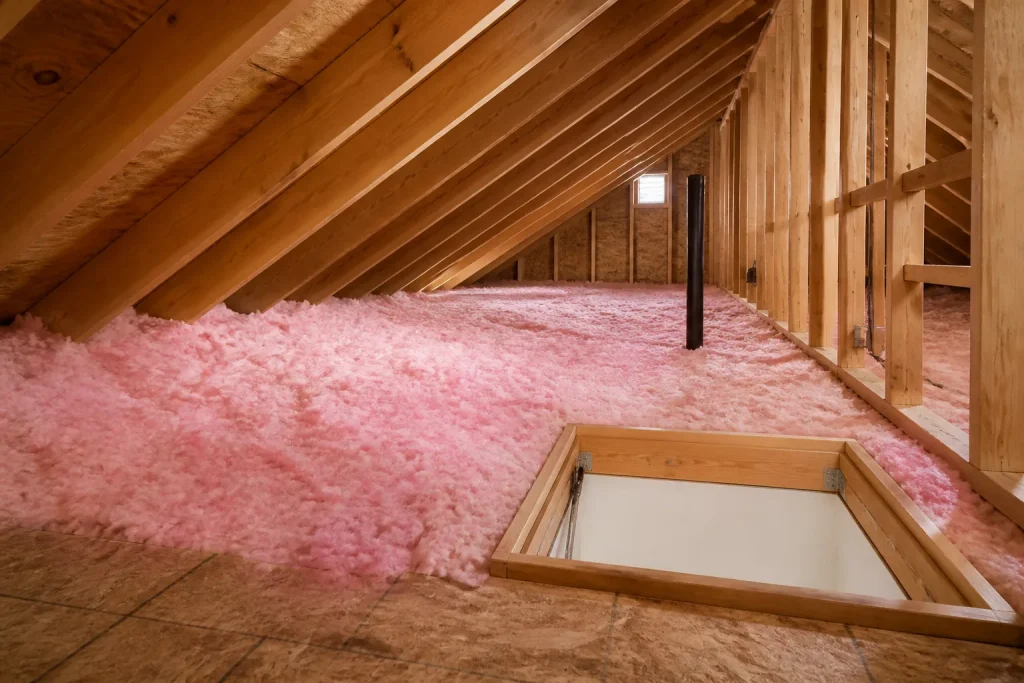
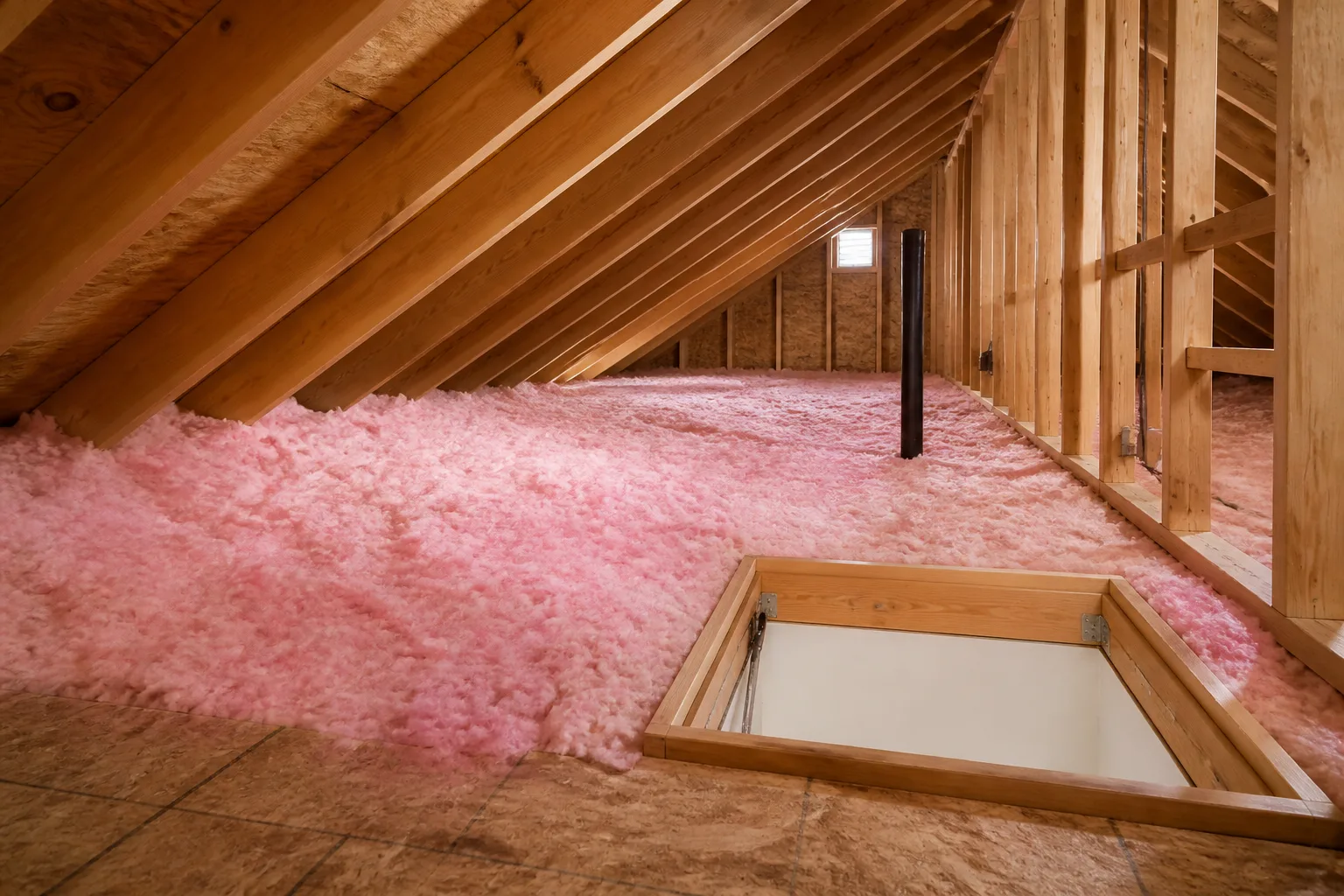
Here’s where Owens Corning gets specific. To reach R-38 with AttiCat loose-fill fiberglass, the installed depth matters as much as the number of bags. Owens Corning’s published coverage chart specifies roughly 15 inches of settled depth for R-38 using their standard AttiCat product. Blow it to 11 inches and you’re sitting somewhere around R-25 or R-30, depending on density. Same pink bag. Very different result.
In our experience across Enterprise, the most common failure we find isn’t the wrong brand. It’s the right brand installed too shallow. Attics in older Enterprise neighborhoods like the ones near the Mountain Vista and John May life estate corridors often have settled to 6 or 7 inches over time, which is closer to R-13 than anything useful.
- Target R-value for Zone 3B: R-38 minimum for attic floors
- Owens Corning AttiCat settled depth for R-38: approximately 15 inches
- What a 15-inch job looks like: a healthy layer that hides the ceiling joists
- What an under-blown job looks like: joists still visible, fiberglass level with the wood
If you want the full picture on how depth and density translate to comfort in Enterprise, our Attic Insulation in Enterprise page walks through the whole process.
How Do You Read the Coverage Chart on the Bag?
The coverage chart is printed on the back of every bag of Owens Corning AttiCat, and it works like this: it lists target R-values in one column, minimum settled depth in another, and the number of bags required per 1,000 square feet in a third. Sound complicated? It’s closer to a recipe card than a physics paper.
Cross-check the installer’s math yourself with these steps:
- Measure your attic’s square footage. If it’s 1,600 square feet, write that down.
- Find the chart on the bag. Look up R-38.
- Note the bags-per-1,000-square-feet figure. For AttiCat at R-38, that’s typically around 24 to 25 bags per 1,000 square feet, depending on the product variant.
- Multiply that by your square footage divided by 1,000. For 1,600 square feet, that’s roughly 38 to 40 bags.
- Count the empty bags. A reputable installer will leave them visible or photograph them for you.
One thing to watch: some contractors quote “R-38 bags” as if the number is fixed, then use a lesser product line. The chart is product-specific. If you don’t see bag counts in your written quote, ask. When we price a job in Enterprise, we write the bag count and target depth into the estimate so there’s no ambiguity later. We’ve also pulled attics where an installer scattered 20 bags across 1,800 square feet and called it R-38, which is closer to R-20 at best.
Batts vs. Blown-In: Which Owens Corning Product for Which Ceiling?
Owens Corning’s pink fiberglass batts and AttiCat blown-in fiberglass are both fiberglass, but they solve different problems. Getting this wrong in an Enterprise home means paying for insulation that never performs the way the label promises.
- Attic floor (what most Enterprise homeowners need): AttiCat blown-in. Loose fibers blow into every cavity and gap, filling around joists, plumbing penetrations, and ductwork. It reaches high R-values with less fuss than stacking batts.
- Sloped ceilings in Nevada homes: higher-density batts, sometimes paired with spray foam at the roof deck. A sloped ceiling doesn’t leave a horizontal surface to blow onto. Batts cut to fit or foam applied to the underside of the roof sheathing work better here.
- Vaulted or cathedral ceilings: spray foam territory. AttiCat can’t be blown into a cavity that doesn’t exist in a horizontal plane.
- Knee walls and tight corners: batts, sometimes backed with blown-in where the geometry allows.
Enterprise homes tend to have a mix. Ceiling loads are high, roof pitches vary wildly from flat 1970s builds to steeper newer construction, and duct runs through the attic are common. We’ve seen plenty of jobs where the installer blew AttiCat flawlessly into the flat attic floor but left the sloped bedroom ceiling cavity totally bare. That room stays uncomfortable no matter how much you dump into the horizontal section. Our Blown In Insulation in Enterprise page goes deeper on the horizontal-floor case, and the Spray Foam Insulation in Enterprise page covers the sloped and vaulted situations.
What Does “Owens Corning Preferred Contractor” Actually Mean?
The Owens Corning Preferred Contractor program is a manufacturer designation, not a DIY quality signal. Contractors apply, meet minimum requirements for insurance, licensing, and installation experience, and commit to using Owens Corning materials. In exchange, they get marketing support and sometimes extended product warranty coverage for homeowners.
If a contractor claims Preferred status, ask these questions:
- Can you show me documentation of your current status? The program has tiers, and “preferred” vs. “platinum” matters for warranty length.
- Which Owens Corning warranty tier does your status unlock for me?
- Do you install other brands as well, and if so, when do you pick Owens Corning over Johns Manville or Knauf?
- Who handles a warranty claim, you or Owens Corning?
Preferred status is a real signal, but it’s not the whole story. We source from Owens Corning and seven other brands because the right product for a given Enterprise attic depends on the geometry, the moisture profile, and the budget. A contractor with Preferred status and thin installation practices still gives you an under-blown attic. The status sits beside the workmanship question; it doesn’t replace it.
Product Warranty vs. Workmanship Warranty: What Covers What?
Owens Corning’s product warranty covers the material itself. If the fiberglass fails because of a manufacturing defect, Owens Corning replaces the product. That’s it. What it does not cover is whether the product was installed at the correct depth, with the correct density, in the correct pattern for your attic. That’s the contractor’s responsibility.
| Warranty type | Who backs it | What it covers |
|---|---|---|
| Owens Corning product warranty | Owens Corning | Manufacturing defects in the insulation material |
| Installer workmanship warranty | Your contractor | Installation errors: wrong depth, missed cavities, compressed batts, damaged vapor barriers |
| Extended manufacturer warranty (Preferred tier) | Owens Corning | Product plus limited labor, terms vary by tier |
Get both in writing before work begins. The workmanship warranty is the one that protects you when the job was rushed. Ours runs 365 days, covers labor and materials, and comes with a free second visit if a repair fails. If someone shows up at your Enterprise door with a verbal promise and no written workmanship warranty, that’s the conversation to have before anyone gets on a ladder.
When to call a pro
Attic insulation work over 100°F can turn dangerous fast, and ceiling cavities with settled old fiberglass are not a DIY zone. If your attic is over 8 inches thick with settled material, or if you can’t see the joists clearly, get a professional assessment before touching anything. Techs are background-checked, identity-verified, and sent to you by name and photo before the visit, so you know exactly who’s coming through the door.
What Should Owens Corning Attic Insulation Cost in Enterprise?
For a typical 1,200 to 1,600 square foot Enterprise attic, Owens Corning AttiCat blown-in insulation runs roughly $1,400 to $2,600 installed, depending on the attic’s starting condition, whether old material needs removal, and how many air-sealing details need attention. That includes the correct bag count for R-38, a target-depth written into the quote, and cleanup of the old material haze.
- Blown-in AttiCat, R-38 target: $1,400 to $2,600 typical range
- Air sealing before blow-in: $200 to $500 add-on depending on penetrations
- Old insulation removal: $400 to $900 if contaminated or severely compressed
- Sloped or vaulted ceiling with spray foam: priced separately, higher per square foot
Every job gets a written price before any work starts. No surprises on the invoice, no post-job additions. If you’re comparing two quotes in Enterprise and one is dramatically lower, ask what R-value and bag count it includes. The gap is almost always depth.
The Bottom Line
The Owens Corning name on the bag tells you the material is solid. It tells you nothing about whether the installer hit 15 inches of settled depth, counted the bags, or sealed the top plates before blowing. Hold your contractor to the published coverage chart, get the workmanship warranty in writing, and confirm the bag count matches your attic’s square footage. That’s how you get a real R-38 instead of the R-20 that looked fine on paper. If you’re in Enterprise and need help, Aspen Attic Insulation Enterprise offers free estimates. Call (844) 761-9996 to schedule one and we’ll bring the chart with us.
Frequently Asked Questions
Roughly 24 to 25 bags per 1,000 square feet of attic floor for standard AttiCat at R-38, blown to about 15 inches of settled depth. Check the specific chart on your product variant’s bag before you order. Call (844) 761-9996 for a free measurement and bag-count estimate.
Yes, but usually as fiberglass batts rather than AttiCat blown-in. Sloped and vaulted ceilings don’t leave a horizontal surface to blow onto, so batts cut to fit or spray foam on the underside of the roof sheathing handle those cavities. AttiCat wins on flat attic floors; batts and foam win on slopes.
No. The Owens Corning product warranty covers manufacturing defects in the material. Installation errors, wrong depth, missed cavities, and compressed batts fall to the contractor’s workmanship warranty. Get that warranty in writing, and understand what it covers before anyone climbs into your attic.
Most single-story Enterprise attics take three to five hours including air sealing and cleanup, assuming no old material removal. Contaminated or heavily compressed attics add a half day or more. Call (844) 761-9996 to get a time estimate matched to your specific attic.
Blown-in fiberglass and blown-in mineral wool like Rockwool or CertainTecd products can be blended in most cases, but the coverage chart for R-value calculation gets murky. If your attic has a mix of products, you’ll want a professional to assess actual settled depth before adding material. Mixing is common in Enterprise, and getting the number right matters.
Written by the team at Aspen Attic Insulation Enterprise.
Need Insulation Help?
Call Aspen Attic Insulation Enterprise - licensed & insured, here with fast after-hours help in Enterprise.
(844) 761-9996