
GreenFiber Attic Insulation in Enterprise: A Homeowner’s Guide
GreenFiber is post-consumer recycled paper treated with borate, an EPA-recognized fire retardant and pest deterrent. Installed at the right depth for Enterprise’s climate, it delivers R-3.7 per inch settled, hitting R-38 at roughly 10.25 inches and R-49 at roughly 13.25 inches. The part most spec sheets skip: borate chemistry behaves differently in desert air than in humid climates where the product was tested, and that’s where GreenFiber jobs in Enterprise go wrong. The short version is that GreenFiber is a legitimate choice for Enterprise attics, provided it’s installed to the right depth, documented properly, and revisited as it settles. If you’d rather not climb into a 140-degree attic to verify, call (844) 761-9996 and we’ll start with a free estimate.
Here’s what we want you to walk away knowing: what GreenFiber actually is, what it costs, how it compares to blown fiberglass, and what your paperwork should say after the install is done.
What Is GreenFiber and Why Does the Composition Matter in Enterprise?
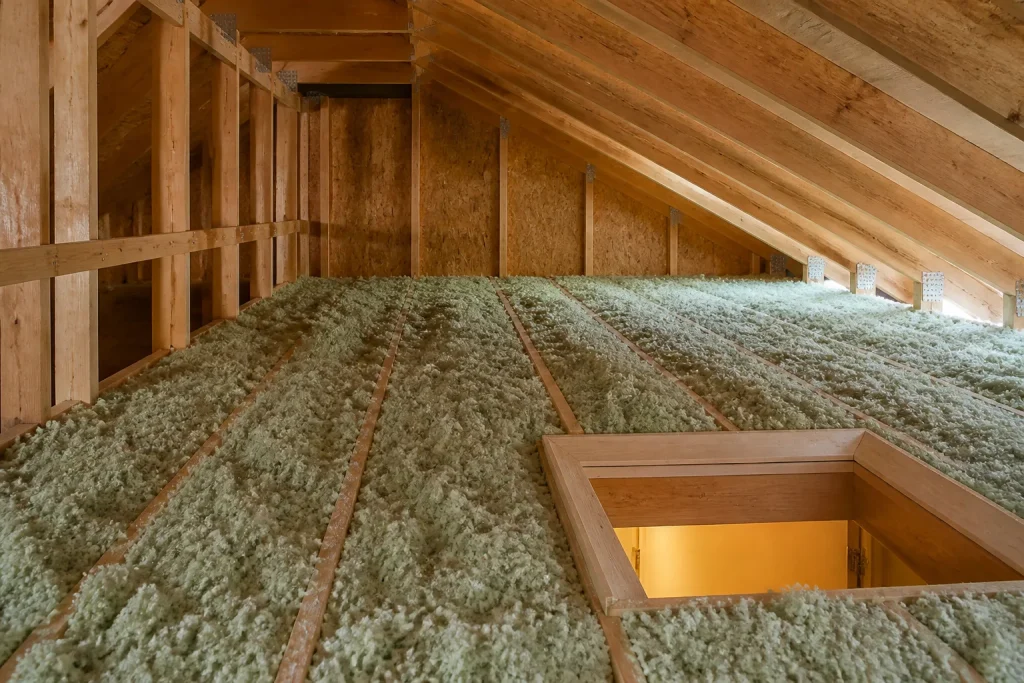
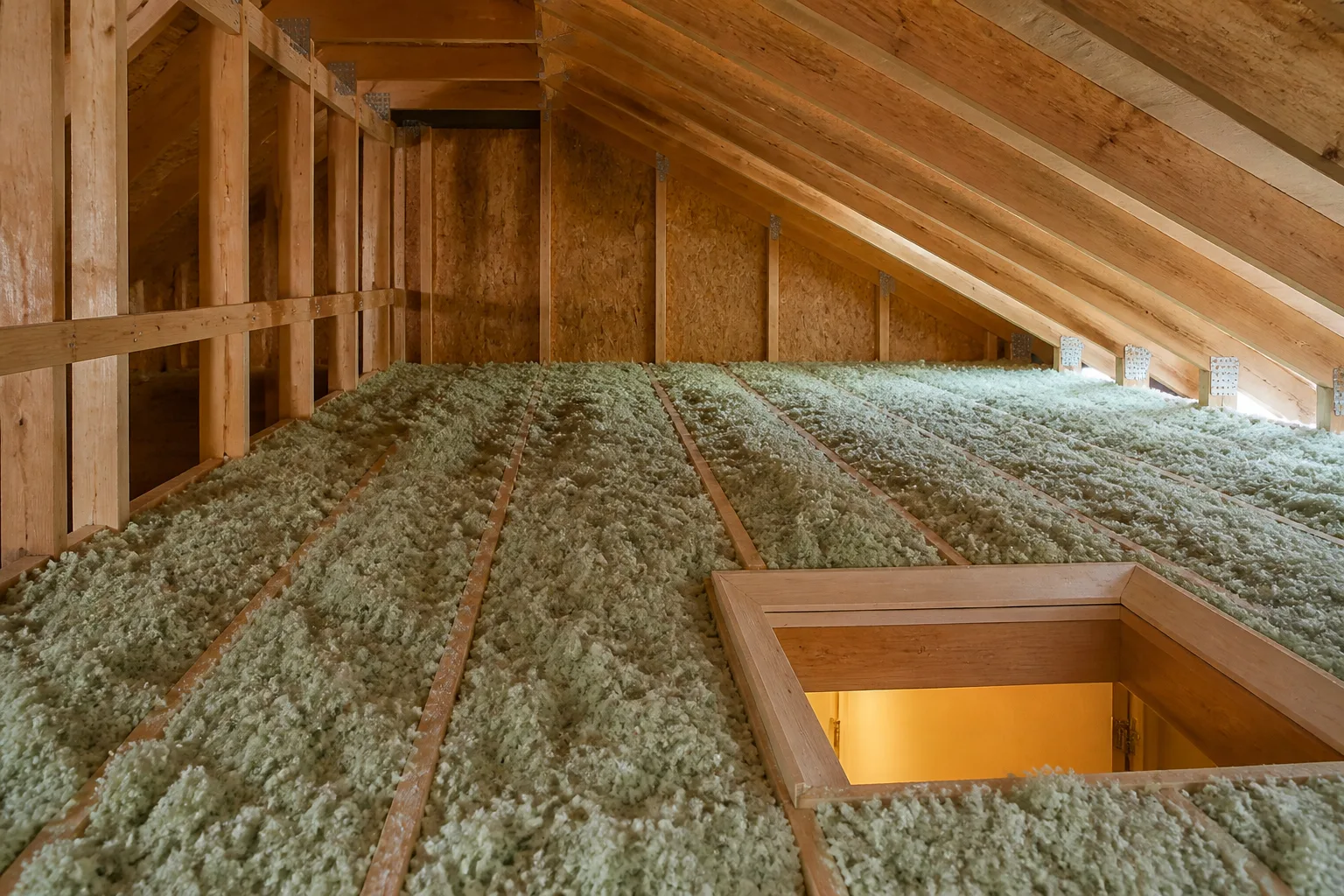
GreenFiber is a cellulose insulation made from roughly 80% post-consumer recycled paper, treated with borate (a naturally occurring mineral salt) to resist fire, mold, and insects. It’s blown in loose, meaning fibers are shot into the attic cavity to fill gaps, corners, and framing members that batt insulation typically misses. The fibers settle into the shape of whatever they’re blown into, which is why coverage is often more complete than rigid products.
In most of the country, that’s the whole story. In Enterprise, though, the story has a second chapter. Our summers push past 110°F, attic temperatures regularly hit 150°F or higher, and the ambient humidity stays low enough that your skin cracks in a week. Those conditions affect how GreenFiber performs compared to the humid-climate data in its published specs.
Specifically:
- Borate fire retardant: The borate salts raised the ignition threshold, which is why cellulose typically outperforms fiberglass in a house fire scenario. That part holds in Enterprise. What changes is what happens to those salts over years of extreme heat cycling and very low moisture: they can crystallize or migrate within the settled material, which affects the effective depth of coverage over time.
- Density and settling: GreenFiber settles more than fiberglass over the life of the installation. Published specs account for typical settling, but we’ve seen Enterprise attics settle faster than the manufacturer’s charts suggest because the extreme dry heat accelerates compaction. That means the depth you paid for on day one may not be the depth you have in year five.
- UV exposure: Neither cellulose nor fiberglass tolerates direct UV. Attic vents, gable openings, and recessed can lights let UV through. In a sun-drenched Enterprise attic, any exposed patch degrades faster than in cloudier climates.
None of that makes GreenFiber a bad choice for an Enterprise home. It makes correct installation depth and honest documentation more important here than the product brochure implies.
What R-Value Does GreenFiber Deliver, and What Depth Do Enterprise Homes Need?
GreenFiber settles to about R-3.7 per inch. That’s the number to anchor on. Here’s what it means for Enterprise attics targeting the two common benchmarks:
- R-38 target (common for older Enterprise homes): about 10.25 inches installed depth, and closer to 11 inches if you’re accounting for five-year settling.
- R-49 target (current DOE recommendation for our climate zone): about 13.25 inches installed depth, and closer to 14 inches to stay above the target after settling.
Those depths are why bag count matters. A bag of GreenFiber covers a stated square footage at a stated depth on the label. If a crew blows 14 bags into an attic that needs 22, you’ll see the target number on your invoice but not in your attic. We’ve pulled attic samples in Enterprise where the label said R-49 and the tape measure said R-30. It happens more than it should.
If you’re comparing options side by side, our guide to Blown In Insulation in Enterprise covers fiberglass depths and coverage on the same attic sizes, which makes the side-by-side easier.
One thing nobody puts in the brochure: in Enterprise, we routinely see settled depth drop 1 to 1.5 inches in the first three years even on properly installed GreenFiber jobs. That’s not a defect. It’s the product behaving like cellulose in dry heat. Budget for one top-up in the first five years and you won’t be surprised.
Does GreenFiber Handle Moisture Well Enough for a Desert Climate?
Yes, and this is where the marketing gets ahead of the reality. GreenFiber publishes strong moisture resistance data, and that’s a real advantage over standard cellulose. But GreenFiber’s moisture data was largely developed for humid regions where the risk is rain intrusion through the roof deck or plumbing leaks. In Enterprise, the moisture risk comes from somewhere else entirely: HVAC duct condensation.
Here’s what we mean. In a properly operating Enterprise home, the air conditioning runs hard for six months. Supply ducts in the attic are cold, the attic air around them is hot, and any gap in the duct insulation lets condensation form right where it meets the attic floor. If that condensate drips onto GreenFiber, the borate treatment resists mold better than untreated cellulose would, but the insulation still clumps and loses R-value in the wet spot. We’ve opened Enterprise attics with a clear wet stripe running the length of a duct run and GreenFiber matted down along it. The product worked as designed; the duct didn’t.
What we check before recommending GreenFiber in an Enterprise attic:
- Duct insulation integrity along every run, prioritized near the air handler.
- Bathroom and kitchen exhaust terminations – if they dump into the attic (they shouldn’t, but many do), moisture goes straight into the insulation.
- Roof deck condition – any active leak disqualifies a blow-in until it’s fixed.
- Recessed light and ceiling penetration seals – gaps let in both heat and occasional moisture.
If those checks pass, GreenFiber’s moisture profile in an Enterprise attic is genuinely strong. Where you’re likely to see trouble is where ducts and GreenFiber have been fighting each other for years. We like to resolve that conflict before new insulation goes in.
GreenFiber vs. Blown Fiberglass: What Does Each Cost in Enterprise?
Here’s the honest cost comparison for a typical Enterprise attic of 1,200 square feet, brought from R-19 to R-49. Numbers are ballpark, and your written estimate will be exact.
| Line item | GreenFiber (cellulose) | Blown fiberglass |
|---|---|---|
| Material cost per square foot (R-49) | $1.15 – $1.65 | $0.95 – $1.40 |
| Labor per square foot | $0.55 – $0.85 | $0.55 – $0.85 |
| Installed total, 1,200 sq ft attic | $2,050 – $3,000 | $1,800 – $2,700 |
| Expected top-up interval (Enterprise climate) | 4 – 7 years | 8 – 12 years |
| Air sealing (blown-in job, add-on) | $300 – $600 | $300 – $600 |
Read that table carefully and you’ll notice the top-up interval matters more than the per-square-foot difference. GreenFiber typically lands $150 to $350 more than blown fiberglass on a typical Enterprise attic, and it needs a top-up sooner because it settles faster. Blown fiberglass costs less up front and holds its depth longer, but it doesn’t provide the air-sealing effect cellulose does, and in a 150°F attic, the difference in how each material handles heat cycling shows up in the long-run top-up schedule.
Where GreenFiber earns its premium in an Enterprise home is in fire resistance and sound control. Where fiberglass wins is on the initial invoice and on the depth retention curve. Neither is “better” on its own; the answer depends on your attic’s specific conditions. In our experience, GreenFiber tends to be the right call for homeowners who are staying put for a decade or more and want the fire performance, while fiberglass makes more financial sense for owners planning to sell within five years. If you want to compare spray foam in the same conversation, our Spray Foam Insulation in Enterprise page covers that option.
How Does Aspen Specify and Document a GreenFiber Job?
This is the part most contractors gloss over: what’s actually written down. Every GreenFiber job we install comes with a written price before any work starts, and that document spells out exactly what goes into your attic:
- Product name and manufacturer (in this case, GreenFiber – not “cellulose” generically)
- Target installed depth in inches, and the R-value that depth delivers
- Bag count required to hit that depth at your attic’s square footage
- Existing conditions found – duct integrity, venting, prior insulation type and depth
- Any prep included – air sealing, baffle installation, light can sealing
- Total price, itemized, in writing, before we open a bag
That documentation is your protection. It’s also one reason we work with materials from Owens Corning, Johns Manville, and Knauf alongside GreenFiber, since matching the product to the attic matters more than stocking one brand. The best material in the world installed at the wrong depth is a problem, which is why the bag count lives on your paperwork.
Every job is covered by our 365-Day Done Right Promise – if the depth comes up short or a repair fails within the first year, we come back and make it right at no cost to you. And every technician who steps into your attic is background-checked, photo-badged, and sent to you by name and photo before the visit, so you know exactly who’s coming through the door. Every technician carries up to 24 years of experience in residential attic work.
When to Call a Pro
Attic insulation is one of the rare home improvements you can genuinely evaluate yourself before paying anyone. Go up, look at the depth, feel the duct runs, look for water stains, and take a photo. If your attic is under R-30 by depth, if the ducts are dripping condensation, or if a prior blow-in job is thinner than the label said, it’s worth a professional assessment. What we’d rather you didn’t do is blow new insulation over a duct problem – that just costs you twice.
For the full picture on how we work with each material, start at the Aspen Attic Insulation Enterprise home page or go straight to our Attic Insulation in Enterprise page. GreenFiber is one of several options we install, and the estimate will tell you whether it’s the right one for your attic.
The Bottom Line
GreenFiber is a solid product for Enterprise attics when it’s installed to the correct depth with documented bag counts and a plan for top-up years down the road. It’s a poor choice when a crew blows a target R-value into an attic and doesn’t measure what’s actually there. Two numbers matter most: R-3.7 per inch settled and your attic’s target R-value (R-38 or R-49 for our climate). Get those two right and the rest follows. Budget around $2,050 to $3,000 installed for a 1,200 square foot attic, plan on one top-up within five to seven years, and insist on written documentation of product, depth, and bag count on every job.
If you’re in Enterprise and want an honest read on whether GreenFiber or blown fiberglass is the right fit for your attic, we’ll come out, take measurements, and give you a written price before anything else happens. Call Aspen Attic Insulation Enterprise at (844) 761-9996 – free estimates, and a live person answers the phone every time.
Frequently Asked Questions
About 10.25 inches for R-38 and roughly 13.25 inches for R-49. In Enterprise we install slightly deeper – closer to 11 inches and 14 inches respectively – to account for faster settling in our dry heat. Measure your existing depth before adding anything, since settling may already have taken you below the target.
Not universally. GreenFiber outperforms blown fiberglass on fire resistance and air sealing, but fiberglass costs less up front and settles more slowly in Enterprise’s heat. For homeowners planning to stay long-term and wanting the fire performance, GreenFiber is usually the better fit. For shorter ownership windows, fiberglass often makes more financial sense.
Installed cost typically runs $1.70 to $2.50 per square foot at R-49, putting a 1,200 square foot attic in the $2,050 to $3,000 range including labor. Add $300 to $600 if air sealing is part of the job. Exactly what your attic needs comes out in the written estimate, which is free.
Yes. In Enterprise’s climate, GreenFiber typically settles 1 to 1.5 inches within the first three years, and a top-up is usually wise within five to seven years to maintain your R-value. Building that expectation into your long-term plan is more honest than pretending it doesn’t happen.
Yes. We measure existing depth, verify the bag count the prior installer used against your attic square footage, and top up to the correct target R-value. If the installation was recent and documented, we can also walk you through options. Call (844) 761-9996 and we’ll take a look before recommending anything.
Written by the team at Aspen Attic Insulation Enterprise.
Need Insulation Help?
Call Aspen Attic Insulation Enterprise - licensed & insured, here with fast after-hours help in Enterprise.
(844) 761-9996