
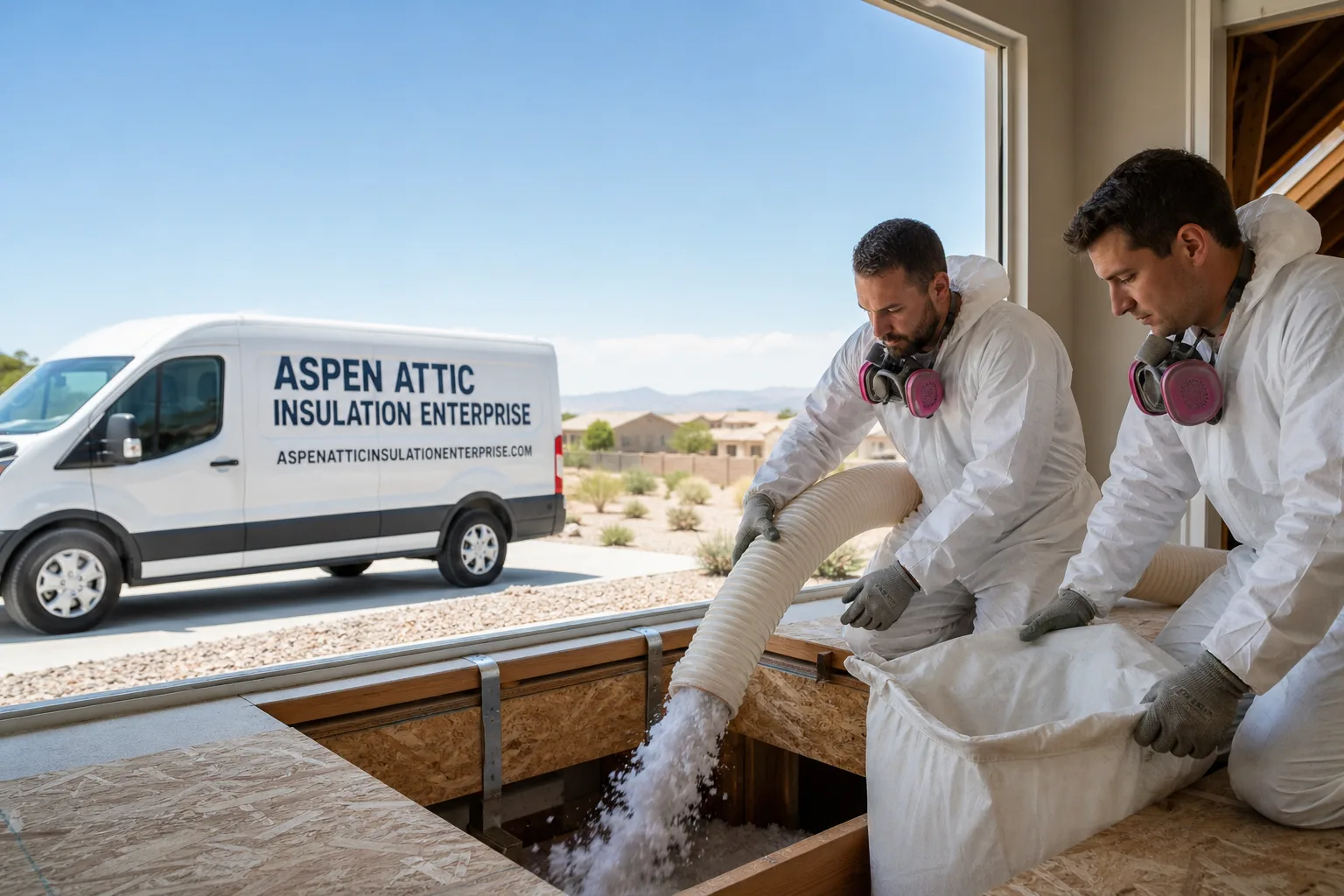
Crawl Space Insulation Cost in Enterprise, NV: What You’ll Actually Pay
Most crawl space insulation work in Enterprise, NV runs between $1,200 and $4,800, and the number depends far more on access than on square footage. That’s the honest range for the two crawl space situations that actually exist here: townhome floor cavities between living levels ($900 to $2,600 for a typical unit) and the rare older home with a true under-floor crawl space ($1,800 to $4,800 including a radiant barrier on the ground-facing side). Call (844) 761-9996 for a written price before anyone touches your home. Estimates are free, and you’ll know the number before work begins.
If you’re in one of Enterprise’s newer townhomes or multi-unit buildings and your first floor runs warm even with the AC blasting, the problem may be an uninsulated floor cavity, and the fix is nothing like the “crawl space insulation” articles written for rainy climates. Most of those guides assume you’re fighting moisture and cold from below. In the Mojave, you’re fighting heat moving up.
Key Takeaways
- Crawl space insulation in Enterprise costs $1,200 to $4,800 depending on access and material.
- The goal here is thermal isolation from lower-level heat, not moisture control.
- Rockwool, Knauf, and closed-cell spray foam handle the job differently. Fire rating matters in shared-floor assemblies.
- Written price includes the access method: panel removal, drilling, or existing hatch.
Why crawl space insulation works differently in Enterprise’s desert climate
National crawl space guides are written for the Pacific Northwest and the Southeast, where the enemy is damp soil, cold air pooling under the floor, and vapor intrusion that rots joists. Enterprise has the opposite problem. The ground is dry, the air is dry, and the heat is relentless. Summer highs average 104°F and spike past 110°F with regularity. There’s no moisture to manage. There’s heat to block.
In a two-story Enterprise townhome, the floor cavity between the first and second level can behave like a thermal transfer zone in reverse. Sun-baked lower walls and slab-adjacent air radiate upward through an uninsulated cavity, and the upstairs floor becomes a warm plate even when the AC is running hard. Insulating that cavity changes the physics. It’s not about keeping cold air down. It’s about interrupting heat’s path up through the building envelope.
That’s a different material selection than the national guides describe. Vapor barriers? Rarely the answer here. Radiant barriers on the ground side? Only sometimes, and only for true under-floor crawl spaces on older homes. Closed-cell spray foam? Yes, and often, because it seals irregular cavities in ways batts can’t. The materials follow the physics, not the internet.
The two crawl space scenarios in Enterprise housing, and what each costs
Enterprise is dominated by 1990s-2010s tract homes with pitched roofs and unfinished attics, plus a growing number of mid-rise apartments and townhomes. That housing mix produces exactly two crawl space scenarios for our technicians.
Scenario 1: Townhome floor cavities between living levels
This is the more common call in Enterprise. The floor cavity between units, or between the first and second floor, sits uninsulated behind drywall and subfloor, and the homeowner notices the first floor runs hot. Access is usually through a mechanical closet ceiling panel or a small hatch, sometimes through drilling from below if no panel exists. Materials that work well here include Rockwool batts (fire-rated and a smart choice in party-floor assemblies), Knauf fiberglass batts (standard joist bays, economical, effective), and closed-cell spray foam for irregular cavities or where air sealing matters.
Scenario 2: True under-floor crawl spaces on older homes
Rare in Enterprise but real. A handful of older homes sit on raised foundations with an actual crawl space under the floor. Those need both insulation at the joist bays and a radiant barrier on the ground-facing side to bounce back the heat radiating up off the soil. Closed-cell spray foam and CertainTeed or Knauf batts are the usual pairing.
| Work Item | Typical Cost in Enterprise |
|---|---|
| Townhome floor cavity, batts (Rockwool or Knauf), typical 400-600 sq ft | $900 – $1,900 |
| Townhome floor cavity, closed-cell spray foam, same size | $1,600 – $2,600 |
| True crawl space, joist-bay batts (older home) | $1,400 – $2,800 |
| True crawl space with radiant barrier, ground-facing side | $1,800 – $4,800 |
| Access panel removal or hatch modification | $75 – $250 |
| Drilling access from below where no hatch exists | $150 – $400 |
Those numbers are what we see in Enterprise, not a national average. The access line matters most, because that’s where estimates go sideways. Read on for why.
The access question that changes your price
Here’s the operator detail that national cost guides never mention: crawl space insulation pricing is 60% an access problem and 40% a materials problem. A townhome cavity that’s reachable through a mechanical closet panel is a two-hour job. The same cavity with no panel and no hatch means drilling from below at the ceiling line, feeding the material through small openings, and patching afterward. Same square footage. Different price.
That’s why our written price includes the access method up front: panel removal, drilling, or existing hatch. If the technician discovers the cavity isn’t accessible from the originally estimated entry point, that’s on us to sort out with you in writing before work continues. No surprise labor. No “the tech found something, that’ll be extra.” The price you signed is the price you pay.
Fire ratings in shared-floor assemblies: a code question, not just an R-value question
In Enterprise’s newer mid-rise apartments, insulating the floor cavity above a parking garage or commercial space is a building-code and fire-rating question before it’s an R-value question. A party-floor assembly between residential units needs a specific fire-resistance rating, and the insulation you put in that cavity has to work with the assembly, not against it. Rockwool is often the right call here because it’s noncombustible and rated for exactly these applications. Cheap fiberglass batts that seem fine on paper can fail the fire rating requirement.
Our technicians assess the fire-rating requirement before recommending materials. That’s part of the Threshold Standard, the verification and conduct protocol every Aspen Attic Insulation Enterprise technician operates under. It’s also why we carry eight material brands (Owens Corning, Johns Manville, Knauf, Rockwool, CertainTeed, Icynene, Demilec, GreenFiber) rather than a single line. The right product for a fire-rated townhome party floor isn’t the right product for an open attic blow-in, and one-size-fits-all manufacturers lose jobs they shouldn’t.
Common local scenarios we see in Enterprise
A townhome near the 215 corridor where the downstairs living room hits 84°F in late July while the upstairs bedrooms stay comfortable. A 1990s tract home on a raised foundation with 150°F attic air baking the shingles from below while the original insulation has compacted into a hard crust. A mid-rise condo above a covered parking garage where the first-floor unit can’t cool down because the floor above the garage was never insulated to fire code. Each of those gets a different written solution, and each is a version of the same problem: an uninsulated cavity doing the wrong job.
If you’re also worried about your attic, the same set of heat-management principles applies there. Our Attic & Crawl Space Restoration in Enterprise service covers the whole envelope together, and it’s often the more honest call when both a floor cavity and an attic are working against you. Our technicians have up to 24 years of experience and every one of them is background-checked, identity-verified, and sent to you by name and photo before the visit. If anyone else arrives, the visit is free. That’s not a slogan. It’s the Threshold Standard.
FAQs
Crawl space insulation in Enterprise runs $1,200 to $4,800 for most homes, with townhome floor cavities typically landing between $900 and $2,600 and true under-floor crawl spaces with radiant barrier at $1,800 to $4,800. The biggest variable is access, not square footage. Call (844) 761-9996 for a written, exact quote. Estimates are free.
Repair is almost always cheaper when the existing insulation is intact but compressed or has lost R-value from heat, and replacement makes sense when material is damaged, contaminated, or the wrong material for the assembly in the first place. In Enterprise, most of what we find is the second case, because builder-grade products were undersized for the desert heat from day one. Call (844) 761-9996 and we’ll tell you honestly which one applies to your home.
Same-day estimates are often possible in Enterprise, and a live person answers the phone 24/7 so you’re not stuck in a voicemail loop. Actual insulation work typically schedules within a few days of the estimate, depending on material availability. Call (844) 761-9996 and we’ll tell you the next opening.
Usually no, and that surprises most homeowners who’ve read national guides. The Mojave is arid enough that moisture control isn’t the primary concern in a crawl space here. Thermal isolation from lower-level heat is.
Get a written price before anyone knocks
Aspen Attic Insulation Enterprise puts the technician’s name, face, and the written price in your hands before the visit. Every job carries the 365-Day Done Right Promise, covering labor and materials for a full year, with a free second visit if a repair fails. Call (844) 761-9996 for a free crawl space insulation estimate in Enterprise, and you’ll know exactly who’s coming and exactly what it costs. No surprises at the door.
Written by the team at Aspen Attic Insulation Enterprise, serving Enterprise, NV.
What Our Customers Say
"The estimate was clear on R-value and cost per square foot. No add-ons."
- Omar N."Blown in cellulose up to R-49 in the attic. Tech badged in at the door and measured the depth with a ruler before and after. Upstairs bedrooms stopped being an oven."
- Fran T."Vetted crew, which I liked. Installed baffles at the eaves so the vents stay clear."
- Sonia B.